This free two-page worksheet turns the 10 practice questions from our TOPIK 6 grammar guide into a printable PDF. Five questions ask you to fill in the blank in a Korean sentence, and five describe a real-life situation and ask which pattern fits. Every choice is one of the 11 TOPIK 6 grammar patterns, so it's a quick way to check what you know before the TOPIK II exam, in class or at home.
What's inside
- 5 fill-in-the-blank questions: a Korean sentence with an English translation. Pick the pattern that completes it; the verb or adjective is given in its dictionary form.
- 5 situation questions: read a short real-life scene and choose the pattern that says what you mean.
- 4 choices per question, all TOPIK 6 patterns, so you have to know the difference, not just recognize the level.
- An answer key with explanations: one line per question on why the answer is right and what the other choices would mean.
Answers are printed upside down at the bottom of each page, so learners can check their own work.
The 10 questions
Prefer to work on screen? These are the same questions as on the worksheet. Choose the best answer for each one, then check the answers below.
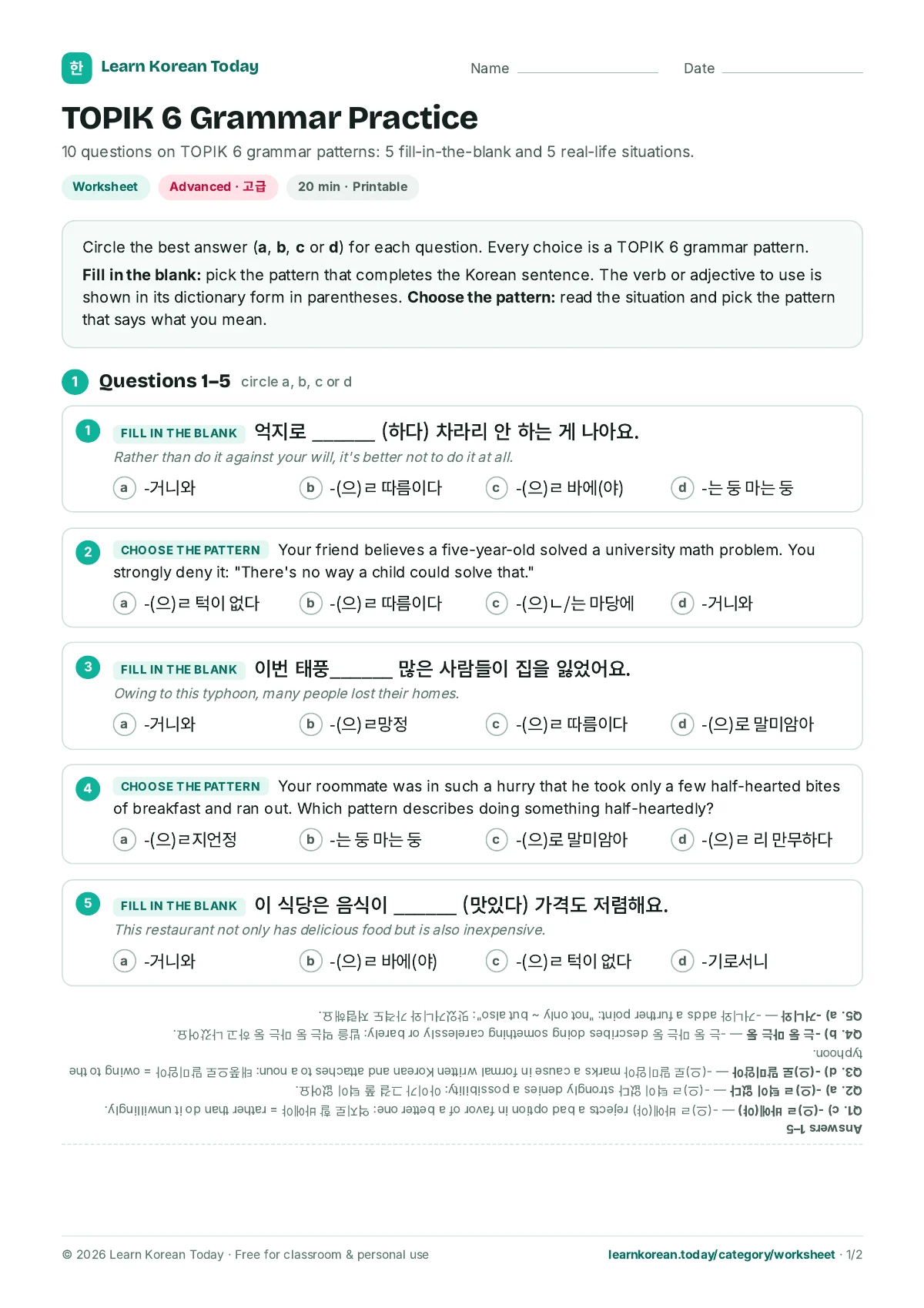
Fill in the blank.
억지로 ______ (하다) 차라리 안 하는 게 나아요.
Rather than do it against your will, it's better not to do it at all.a) -거니와
b) -(으)ㄹ 따름이다
c) -(으)ㄹ 바에(야)
d) -는 둥 마는 둥Choose the pattern.
Your friend believes a five-year-old solved a university math problem. You strongly deny it: "There's no way a child could solve that."
a) -(으)ㄹ 턱이 없다
b) -(으)ㄹ 따름이다
c) -(으)ㄴ/는 마당에
d) -거니와Fill in the blank.
이번 태풍______ 많은 사람들이 집을 잃었어요.
Owing to this typhoon, many people lost their homes.a) -거니와
b) -(으)ㄹ망정
c) -(으)ㄹ 따름이다
d) -(으)로 말미암아Choose the pattern.
Your roommate was in such a hurry that he took only a few half-hearted bites of breakfast and ran out. Which pattern describes doing something half-heartedly?
a) -(으)ㄹ지언정
b) -는 둥 마는 둥
c) -(으)로 말미암아
d) -(으)ㄹ 리 만무하다Fill in the blank.
이 식당은 음식이 ______ (맛있다) 가격도 저렴해요.
This restaurant not only has delicious food but is also inexpensive.a) -거니와
b) -(으)ㄹ 바에(야)
c) -(으)ㄹ 턱이 없다
d) -기로서니Choose the pattern.
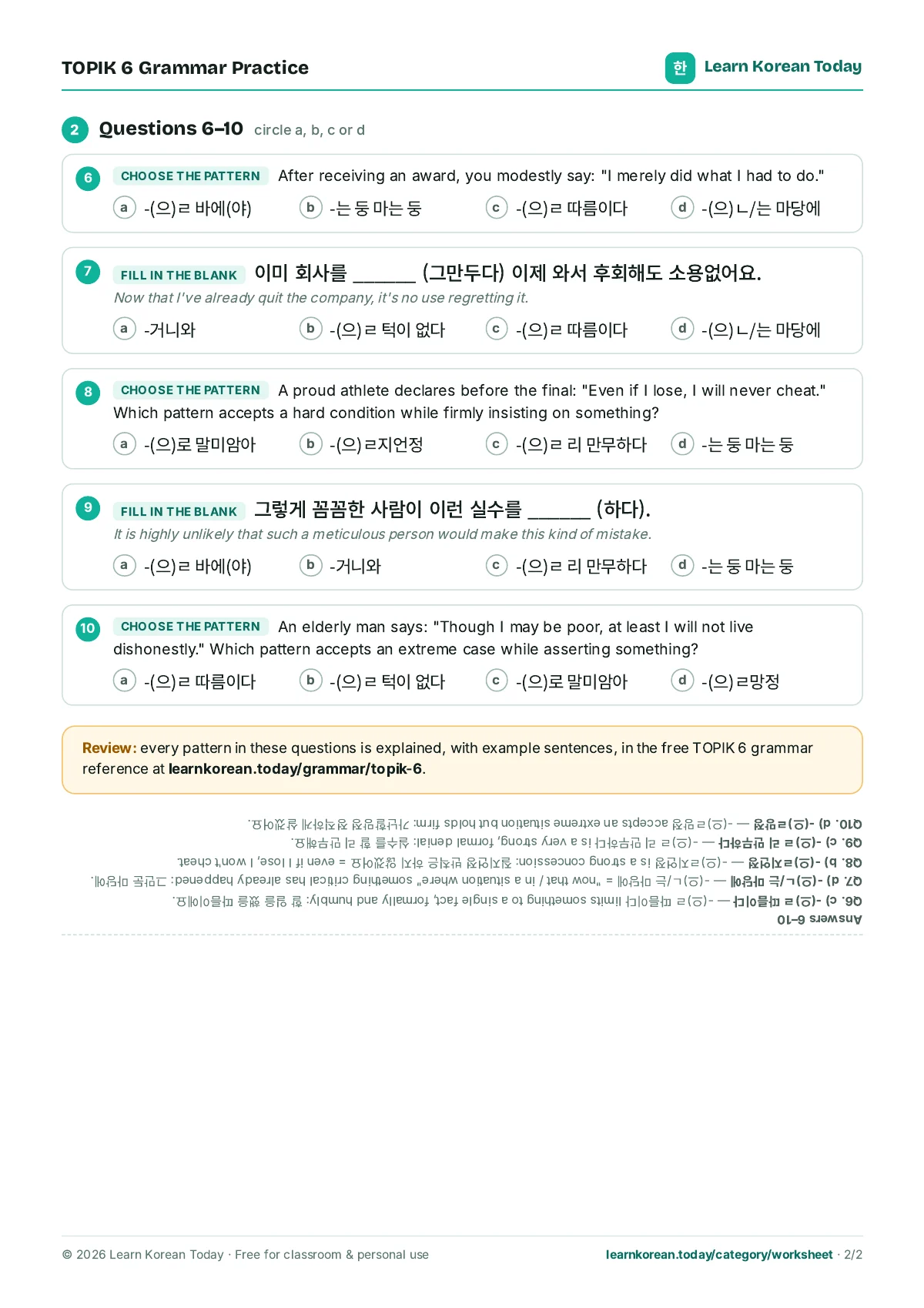
After receiving an award, you modestly say: "I merely did what I had to do."
a) -(으)ㄹ 바에(야)
b) -는 둥 마는 둥
c) -(으)ㄹ 따름이다
d) -(으)ㄴ/는 마당에Fill in the blank.
이미 회사를 ______ (그만두다) 이제 와서 후회해도 소용없어요.
Now that I've already quit the company, it's no use regretting it.a) -거니와
b) -(으)ㄹ 턱이 없다
c) -(으)ㄹ 따름이다
d) -(으)ㄴ/는 마당에Choose the pattern.
A proud athlete declares before the final: "Even if I lose, I will never cheat." Which pattern accepts a hard condition while firmly insisting on something?
a) -(으)로 말미암아
b) -(으)ㄹ지언정
c) -(으)ㄹ 리 만무하다
d) -는 둥 마는 둥Fill in the blank.
그렇게 꼼꼼한 사람이 이런 실수를 ______ (하다).
It is highly unlikely that such a meticulous person would make this kind of mistake.a) -(으)ㄹ 바에(야)
b) -거니와
c) -(으)ㄹ 리 만무하다
d) -는 둥 마는 둥Choose the pattern.
An elderly man says: "Though I may be poor, at least I will not live dishonestly." Which pattern accepts an extreme case while asserting something?
a) -(으)ㄹ 따름이다
b) -(으)ㄹ 턱이 없다
c) -(으)로 말미암아
d) -(으)ㄹ망정
Show answers
Q1. c) -(으)ㄹ 바에(야) — -(으)ㄹ 바에(야) rejects a bad option in favor of a better one: 억지로 할 바에야 = rather than do it unwillingly.
Q2. a) -(으)ㄹ 턱이 없다 — -(으)ㄹ 턱이 없다 strongly denies a possibility: 아이가 그걸 풀 턱이 없어요.
Q3. d) -(으)로 말미암아 — -(으)로 말미암아 marks a cause in formal written Korean and attaches to a noun: 태풍으로 말미암아 = owing to the typhoon.
Q4. b) -는 둥 마는 둥 — -는 둥 마는 둥 describes doing something carelessly or barely: 밥을 먹는 둥 마는 둥 하고 나갔어요.
Q5. a) -거니와 — -거니와 adds a further point: "not only ~ but also": 맛있거니와 가격도 저렴해요.
Q6. c) -(으)ㄹ 따름이다 — -(으)ㄹ 따름이다 limits something to a single fact, formally and humbly: 할 일을 했을 따름이에요.
Q7. d) -(으)ㄴ/는 마당에 — -(으)ㄴ/는 마당에 = "now that / in a situation where" something critical has already happened: 그만둔 마당에.
Q8. b) -(으)ㄹ지언정 — -(으)ㄹ지언정 is a strong concession: 질지언정 반칙은 하지 않겠어요 = even if I lose, I won't cheat.
Q9. c) -(으)ㄹ 리 만무하다 — -(으)ㄹ 리 만무하다 is a very strong, formal denial: 실수를 할 리 만무해요.
Q10. d) -(으)ㄹ망정 — -(으)ㄹ망정 accepts an extreme situation but holds firm: 가난할망정 정직하게 살겠어요.
What's next
Missed a question? Every pattern is explained with example sentences in the TOPIK 6 grammar guide, and the TOPIK 6 grammar reference has a page for each one. TOPIK 6 is the top level, so if these felt easy, try the patterns in real context: our advanced reading lessons use them in full-length Korean news articles. Want a quick review of the basics? Start again from the TOPIK 1 grammar practice worksheet.
Comments (0)
Leave a Comment
Your email address will not be published. Required fields are marked *