This free two-page worksheet turns the 10 practice questions from our TOPIK 3 grammar guide into a printable PDF. Five questions ask you to fill in the blank in a Korean sentence, and five describe a real-life situation and ask which pattern fits. Every choice is one of the 72 TOPIK 3 grammar patterns, so it's a quick way to check what you know before the TOPIK II exam, in class or at home.
What's inside
- 5 fill-in-the-blank questions: a Korean sentence with an English translation. Pick the pattern that completes it; the verb or adjective is given in its dictionary form.
- 5 situation questions: read a short real-life scene and choose the pattern that says what you mean.
- 4 choices per question, all TOPIK 3 patterns, so you have to know the difference, not just recognize the level.
- An answer key with explanations: one line per question on why the answer is right and what the other choices would mean.
Answers are printed upside down at the bottom of each page, so learners can check their own work.
The 10 questions
Prefer to work on screen? These are the same questions as on the worksheet. Choose the best answer for each one, then check the answers below.
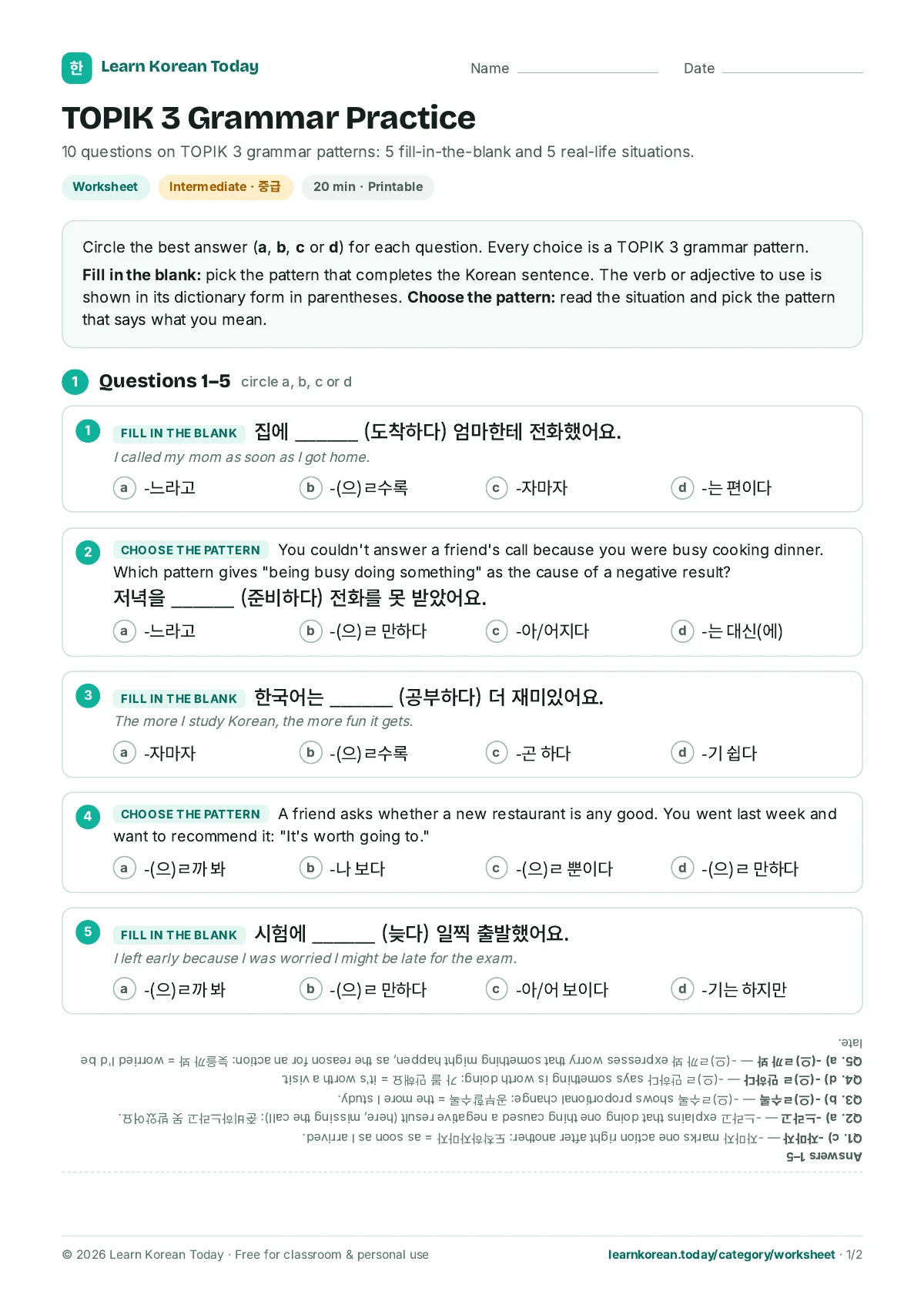
Fill in the blank.
집에 ______ (도착하다) 엄마한테 전화했어요.
I called my mom as soon as I got home.a) -느라고
b) -(으)ㄹ수록
c) -자마자
d) -는 편이다Choose the pattern.
You couldn't answer a friend's call because you were busy cooking dinner. Which pattern gives "being busy doing something" as the cause of a negative result?
저녁을 ______ (준비하다) 전화를 못 받았어요.a) -느라고
b) -(으)ㄹ 만하다
c) -아/어지다
d) -는 대신(에)Fill in the blank.
한국어는 ______ (공부하다) 더 재미있어요.
The more I study Korean, the more fun it gets.a) -자마자
b) -(으)ㄹ수록
c) -곤 하다
d) -기 쉽다Choose the pattern.
A friend asks whether a new restaurant is any good. You went last week and want to recommend it: "It's worth going to."
a) -(으)ㄹ까 봐
b) -나 보다
c) -(으)ㄹ 뿐이다
d) -(으)ㄹ 만하다Fill in the blank.
시험에 ______ (늦다) 일찍 출발했어요.
I left early because I was worried I might be late for the exam.a) -(으)ㄹ까 봐
b) -(으)ㄹ 만하다
c) -아/어 보이다
d) -기는 하지만Choose the pattern.
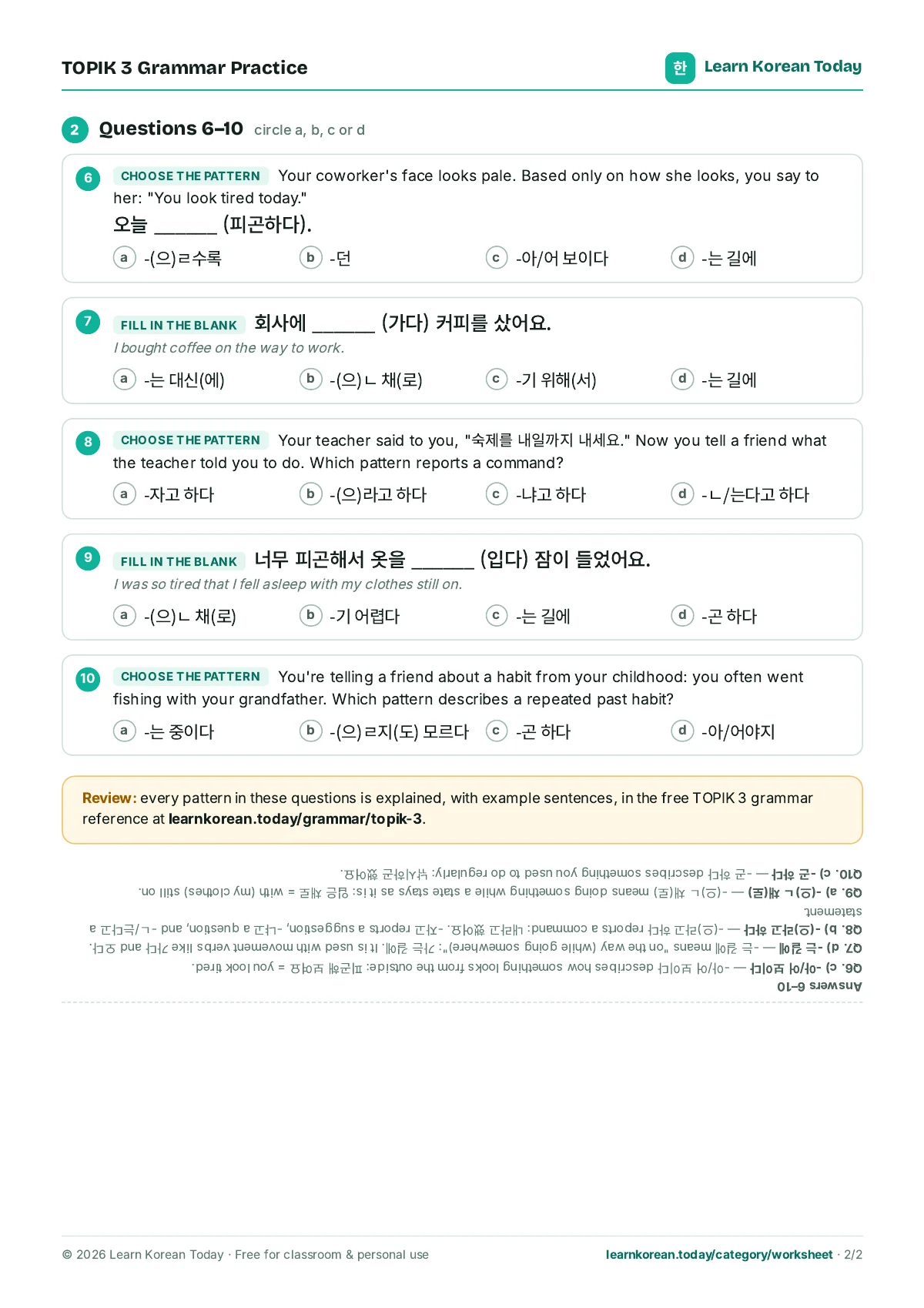
Your coworker's face looks pale. Based only on how she looks, you say to her: "You look tired today."
오늘 ______ (피곤하다).a) -(으)ㄹ수록
b) -던
c) -아/어 보이다
d) -는 길에Fill in the blank.
회사에 ______ (가다) 커피를 샀어요.
I bought coffee on the way to work.a) -는 대신(에)
b) -(으)ㄴ 채(로)
c) -기 위해(서)
d) -는 길에Choose the pattern.
Your teacher said to you, "숙제를 내일까지 내세요." Now you tell a friend what the teacher told you to do. Which pattern reports a command?
a) -자고 하다
b) -(으)라고 하다
c) -냐고 하다
d) -ㄴ/는다고 하다Fill in the blank.
너무 피곤해서 옷을 ______ (입다) 잠이 들었어요.
I was so tired that I fell asleep with my clothes still on.a) -(으)ㄴ 채(로)
b) -기 어렵다
c) -는 길에
d) -곤 하다Choose the pattern.
You're telling a friend about a habit from your childhood: you often went fishing with your grandfather. Which pattern describes a repeated past habit?
a) -는 중이다
b) -(으)ㄹ지(도) 모르다
c) -곤 하다
d) -아/어야지
Show answers
Q1. c) -자마자 — -자마자 marks one action right after another: 도착하자마자 = as soon as I arrived.
Q2. a) -느라고 — -느라고 explains that doing one thing caused a negative result (here, missing the call): 준비하느라고 못 받았어요.
Q3. b) -(으)ㄹ수록 — -(으)ㄹ수록 shows proportional change: 공부할수록 = the more I study.
Q4. d) -(으)ㄹ 만하다 — -(으)ㄹ 만하다 says something is worth doing: 가 볼 만해요 = it's worth a visit.
Q5. a) -(으)ㄹ까 봐 — -(으)ㄹ까 봐 expresses worry that something might happen, as the reason for an action: 늦을까 봐 = worried I'd be late.
Q6. c) -아/어 보이다 — -아/어 보이다 describes how something looks from the outside: 피곤해 보여요 = you look tired.
Q7. d) -는 길에 — -는 길에 means "on the way (while going somewhere)": 가는 길에. It is used with movement verbs like 가다 and 오다.
Q8. b) -(으)라고 하다 — -(으)라고 하다 reports a command: 내라고 했어요. -자고 reports a suggestion, -냐고 a question, and -ㄴ/는다고 a statement.
Q9. a) -(으)ㄴ 채(로) — -(으)ㄴ 채(로) means doing something while a state stays as it is: 입은 채로 = with (my clothes) still on.
Q10. c) -곤 하다 — -곤 하다 describes something you used to do regularly: 낚시하곤 했어요.
What's next
Missed a question? Every pattern is explained with example sentences in the TOPIK 3 grammar guide, and the TOPIK 3 grammar reference has a page for each one. Ready for the next step? The TOPIK 4 grammar practice worksheet has 10 more questions at the next level.
Comments (0)
Leave a Comment
Your email address will not be published. Required fields are marked *