So far, every syllable block you've written had two letters: a consonant and a vowel, like 가 or 나. Many Korean syllables have a third letter at the bottom, called 받침 (batchim, "support"). It appears in almost every Korean sentence, including the word 한국 (Korea) itself. This free two-page worksheet shows where the final consonant goes, teaches the 7 sounds it can make, and gives you tracing, sorting and writing practice with real words.
What's inside
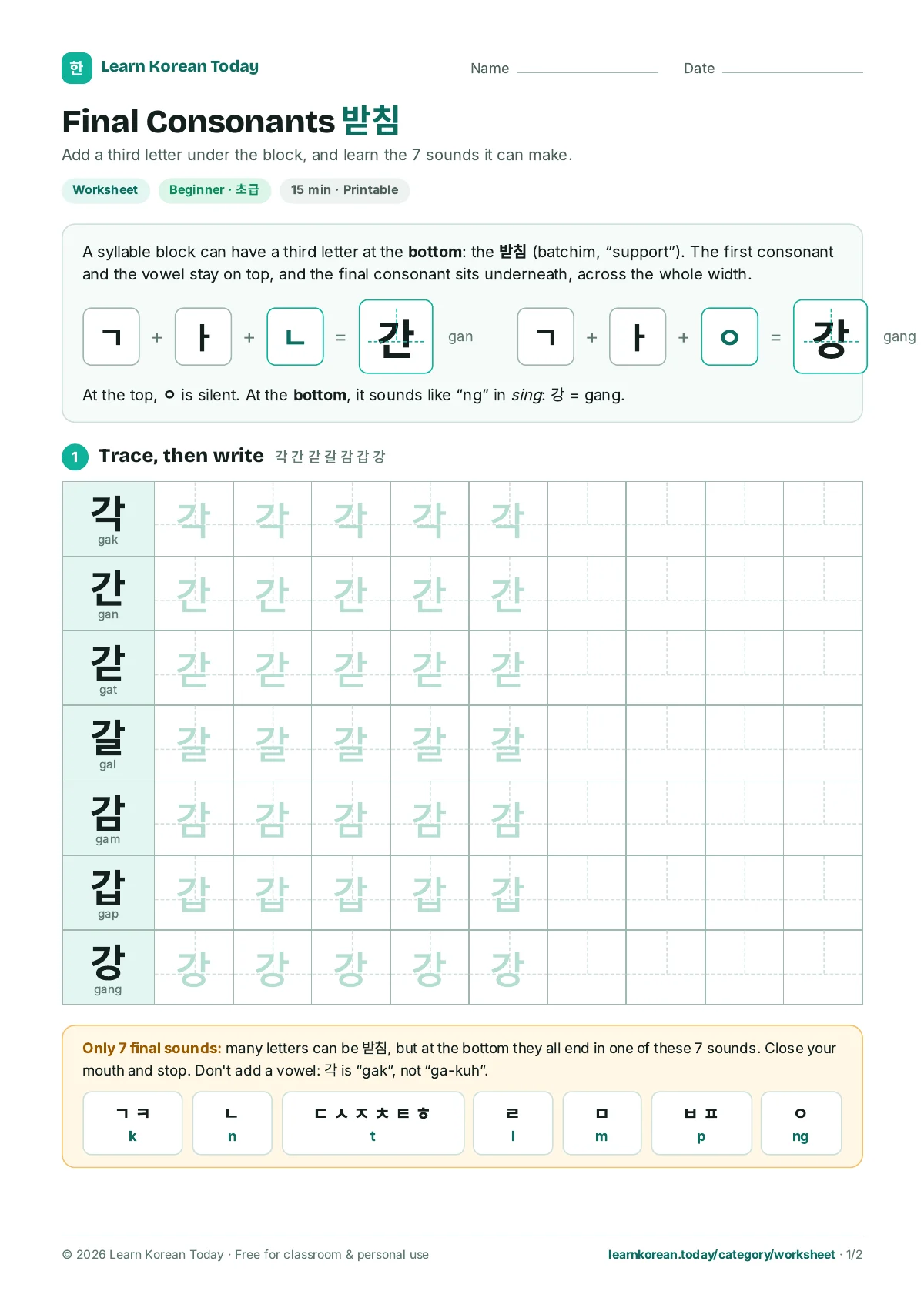
- How 받침 works: ㄱ + ㅏ + ㄴ = 간, with a picture of where each letter goes in the block.
- Trace, then write: 각 간 갇 갈 감 갑 강. That's the same 가 with each of the 7 final sounds. The boxes have guide lines for the top half and the bottom row.
- The 7 final sounds chart, printed right on the page.
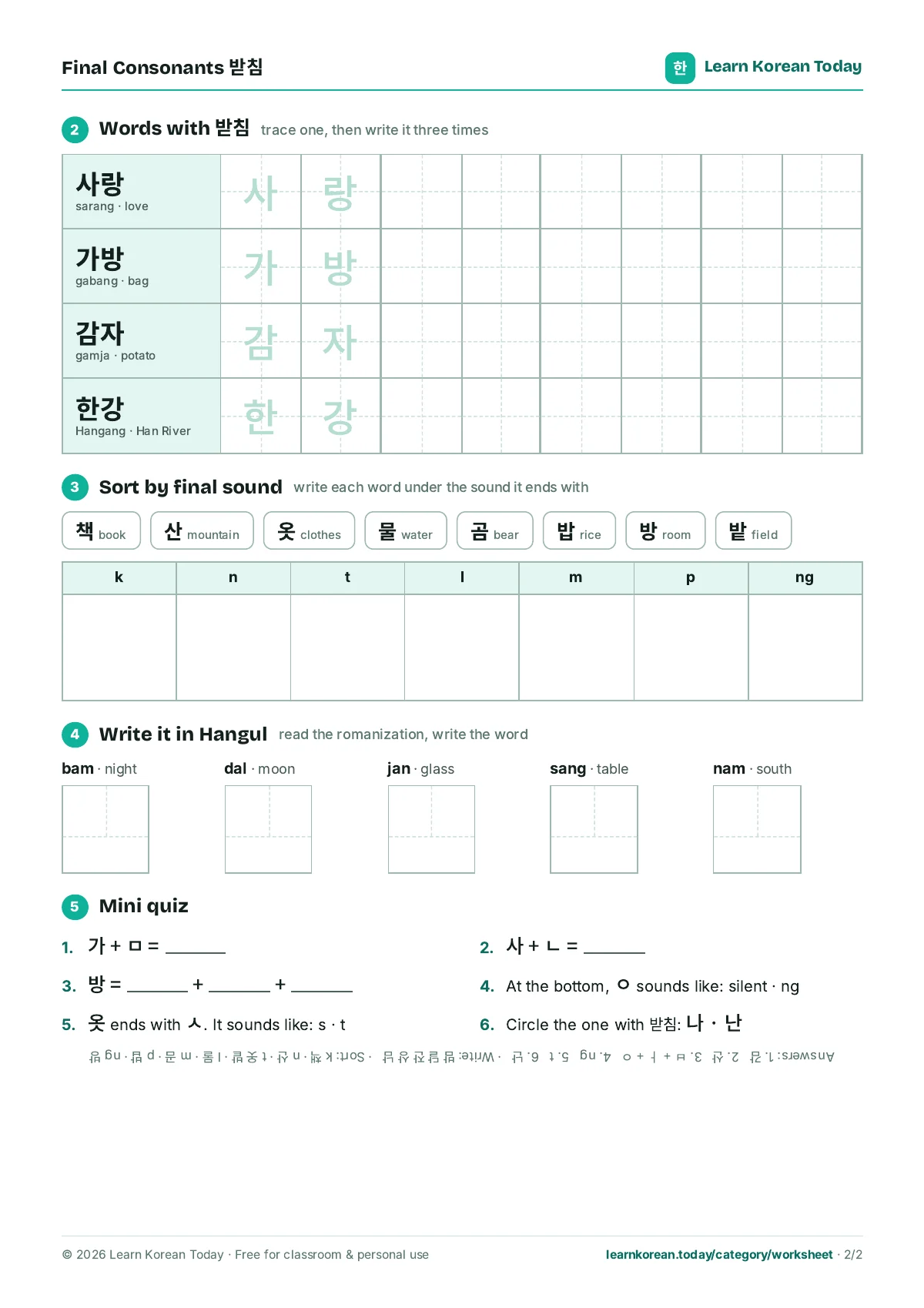
- Words with 받침: 사랑 (love), 가방 (bag), 감자 (potato), 한강 (Han River).
- Sort by final sound: put 책, 산, 옷, 물, 곰, 밥, 방, 밭 under k, n, t, l, m, p or ng.
- Write it in Hangul: read the romanization (bam, dal, jan, sang, nam) and write the word.
- Mini quiz: six questions, with every answer printed upside down at the bottom.
Where the final consonant goes
The first consonant and the vowel stay in the top part of the block, the same as in 가. The 받침 goes underneath and stretches across the whole width:
가 + ㄴ = 간 · 가 + ㅁ = 감 · 가 + ㅇ = 강
With a flat vowel like ㅗ or ㅜ, the block has three layers stacked from top to bottom: 고 + ㅁ = 곰 (bear), 무 + ㄹ = 물 (water). Either way, the final consonant always goes at the bottom.
Watch out for ㅇ. At the top of a block it's silent (아 = "a"), but as 받침 it sounds like the "ng" in sing: 강 = gang, 방 = bang.
The 7 final sounds
Almost any consonant can be written as 받침, but at the bottom of a block every one of them ends in just 7 sounds. You don't need to memorize new sounds, only these groups:
| Written 받침 | Sounds like | Examples |
|---|---|---|
| ㄱ ㅋ ㄲ | k | 책 (chaek, book), 부엌 (bueok, kitchen) |
| ㄴ | n | 산 (san, mountain) |
| ㄷ ㅅ ㅆ ㅈ ㅊ ㅌ ㅎ | t | 옷 (ot, clothes), 낮 (nat, daytime), 밭 (bat, field) |
| ㄹ | l | 물 (mul, water) |
| ㅁ | m | 곰 (gom, bear) |
| ㅂ ㅍ | p | 밥 (bap, rice), 앞 (ap, front) |
| ㅇ | ng | 방 (bang, room) |
Final sounds are unreleased: your mouth moves into position and stops, with no puff of air and no extra vowel. 밥 is "bap", not "ba-puh". Say 갑 and keep your lips closed at the end.
Tips for practicing
- Write top to bottom. First consonant, then the vowel, then the 받침 last.
- Squeeze the top half. With 받침 the top letters get shorter, so the whole syllable still fits in one square. The guide lines in the boxes show where the bottom row starts.
- Spelling isn't sound. 옷, 낮 and 밭 all end in the same "t" sound, but you still have to learn which letter is written. Practice the spelling of the words you use most.
- Listen for the link. When the next syllable starts with ㅇ, the 받침 slides over and is pronounced there: 한국어 is read "han-gu-geo". You'll hear this everywhere once you know it.
Show the answers
Quiz: 1. 감 2. 산 3. ㅂ + ㅏ + ㅇ 4. ng 5. t 6. 난
Write it in Hangul: bam 밤 (night), dal 달 (moon), jan 잔 (glass), sang 상 (table), nam 남 (south)
Sort: k: 책 · n: 산 · t: 옷, 밭 · l: 물 · m: 곰 · p: 밥 · ng: 방
What's next
With consonants, vowels, syllable blocks and 받침, you now know how every Korean syllable is built. The only letters left are the five double consonants (ㄲ ㄸ ㅃ ㅆ ㅉ). Practice them with the double consonants worksheet. The best next step is real reading. Try our beginner reading lessons, or practice the words you meet with flashcards. If any block still feels shaky, go back to the syllable blocks worksheet (가 나 다 라).
Comments (0)
Leave a Comment
Your email address will not be published. Required fields are marked *