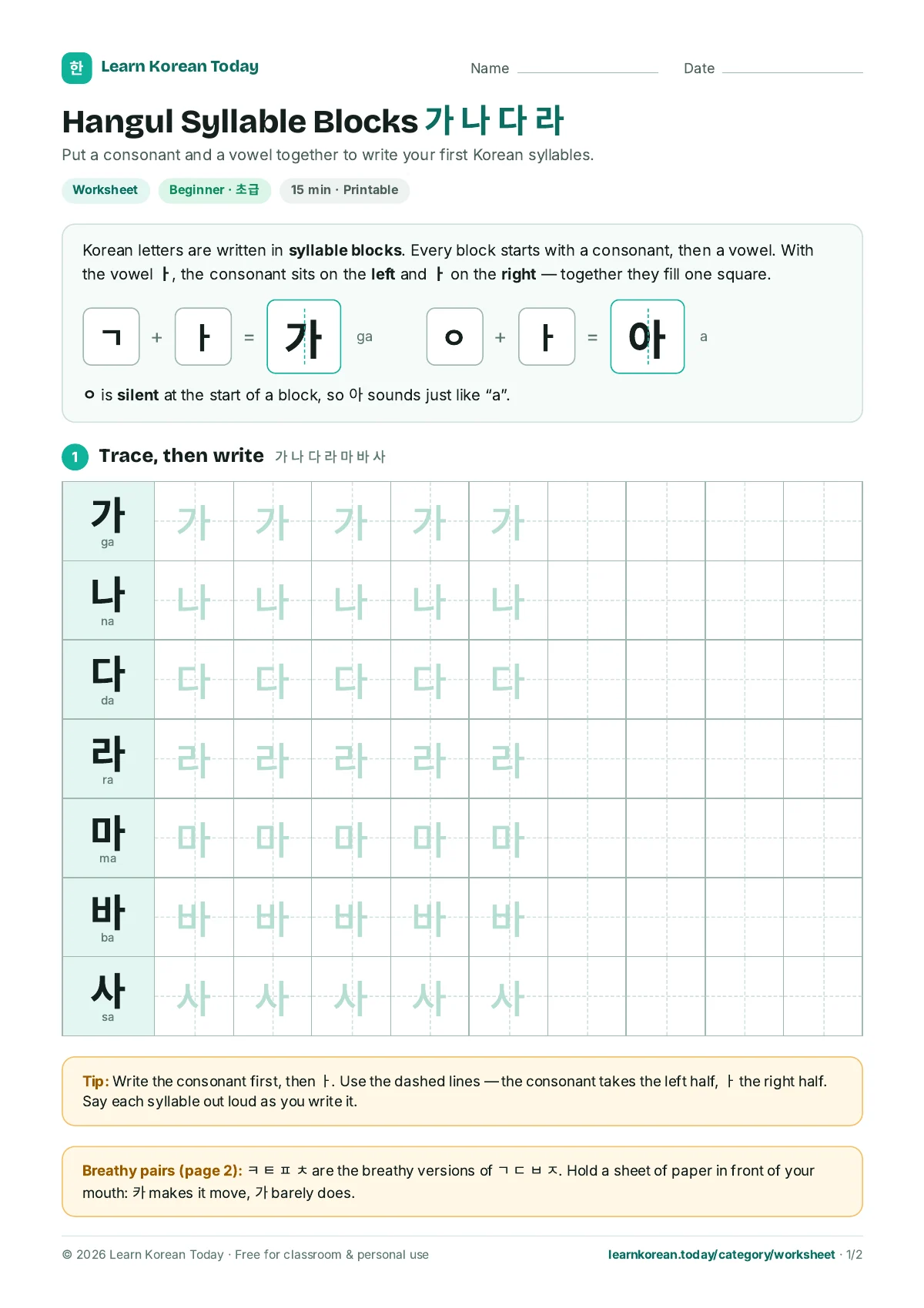
You already know the Korean consonants and vowels. Now it's time to put them together. In Korean, letters are never written in a long line like English. They are grouped into syllable blocks, and every block is read as one syllable. This free two-page worksheet teaches the simplest kind of block, a consonant plus the vowel ㅏ, and gets you writing 14 syllables and your first four Korean words.
What's inside
- How a syllable block works: ㄱ + ㅏ = 가, with a picture of how the two letters share one square.
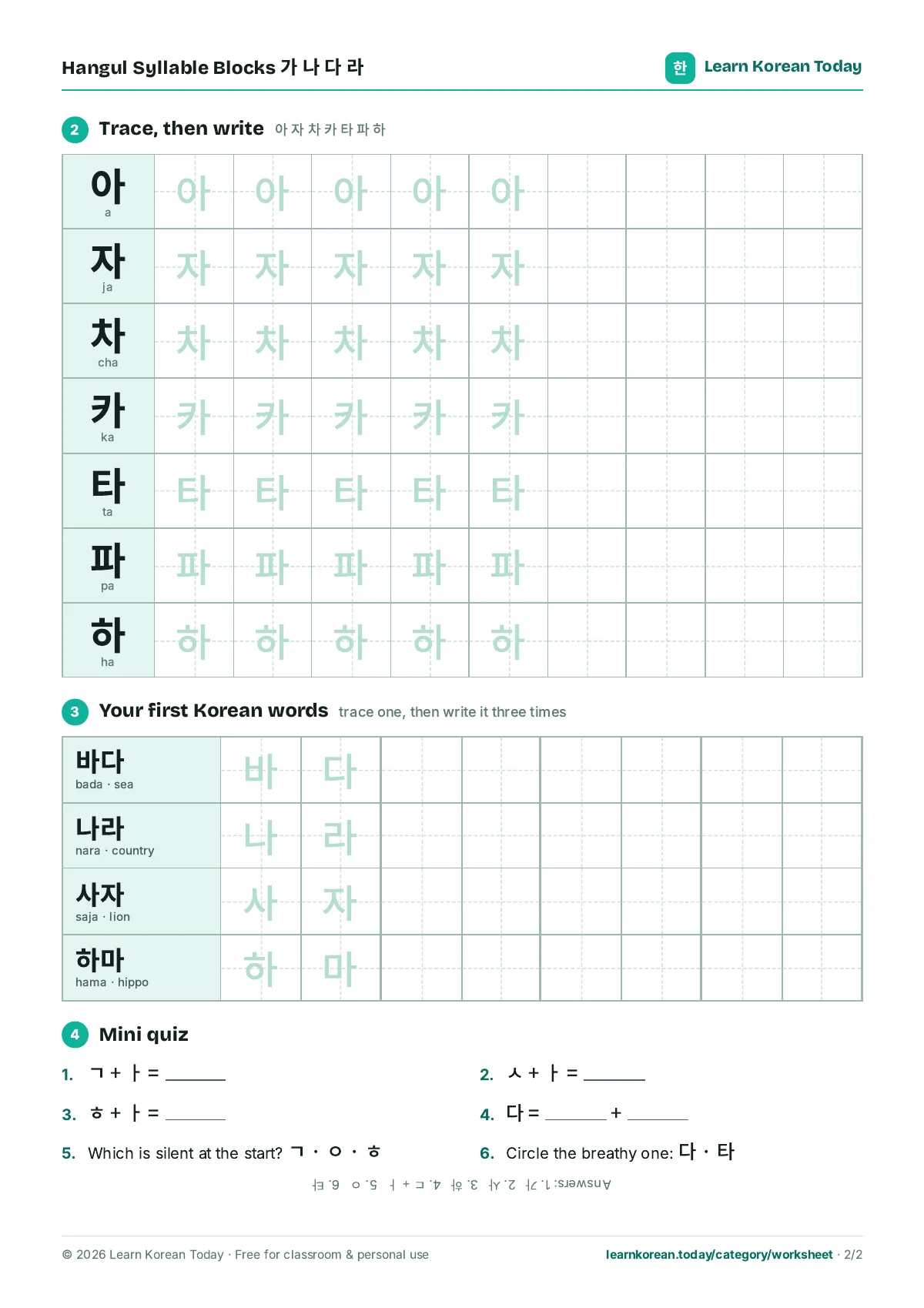
- Trace, then write: 가 나 다 라 마 바 사 on page 1 and 아 자 차 카 타 파 하 on page 2. Each row has a model, five letters to trace, and four empty boxes to write on your own.
- Your first Korean words: 바다 (sea), 나라 (country), 사자 (lion), 하마 (hippo). Each one uses only the syllables you just practiced.
- Mini quiz: six quick questions with the answers printed upside down at the bottom.
How a Korean syllable block works
Every Korean syllable starts with a consonant. The vowel goes next to it or under it, depending on its shape. Tall vowels like ㅏ go on the right, so the consonant takes the left half of the square and ㅏ takes the right half:
ㄱ + ㅏ = 가 · ㄴ + ㅏ = 나 · ㅎ + ㅏ = 하
One special case: ㅇ has no sound at the start of a block. A syllable needs a consonant in the first position, so when it begins with a vowel sound, ㅇ fills the empty spot. That's why 아 sounds just like "a".
The 14 syllables at a glance
| Consonant | + ㅏ | Romanization | Sounds like |
|---|---|---|---|
| ㄱ | 가 | ga | soft "g" in go, halfway to "k" |
| ㄴ | 나 | na | "n" in no |
| ㄷ | 다 | da | soft "d", halfway to "t" |
| ㄹ | 라 | ra | a light tap between "r" and "l" |
| ㅁ | 마 | ma | "m" in mom |
| ㅂ | 바 | ba | soft "b", halfway to "p" |
| ㅅ | 사 | sa | "s" in sun |
| ㅇ | 아 | a | silent: just the vowel "a" |
| ㅈ | 자 | ja | soft "j", halfway to "ch" |
| ㅊ | 차 | cha | "ch" with a puff of air |
| ㅋ | 카 | ka | "k" with a puff of air |
| ㅌ | 타 | ta | "t" with a puff of air |
| ㅍ | 파 | pa | "p" with a puff of air |
| ㅎ | 하 | ha | "h" in hat |
Notice the pairs: ㅋ ㅌ ㅍ ㅊ are the breathy versions of ㄱ ㄷ ㅂ ㅈ. Hold a sheet of paper in front of your mouth. It should move when you say 카 and barely move when you say 가.
Tips for practicing
- Consonant first, then the vowel. Inside each letter, write strokes from top to bottom and from left to right.
- Keep the block square. The dashed lines in every box show the halves. The consonant stays in the left half and ㅏ in the right half.
- Say it out loud every time you write a syllable. Writing and speaking together helps you remember much faster.
- Short and often beats long and rare. One page a day is plenty. Print a fresh copy and repeat until you can write all 14 without looking.
Show the quiz answers
1. 가 2. 사 3. 하 4. ㄷ + ㅏ 5. ㅇ (silent at the start) 6. 타 (the breathy one)
What's next
ㅏ is only one of the vowels. With the other tall vowels, ㅓ, ㅕ and ㅣ, the consonant also sits on the left (거, 너, 기). With the flat vowels, ㅗ, ㅛ, ㅜ, ㅠ and ㅡ, the consonant sits on top (고, 누, 그). Next, add a third letter at the bottom of the block with the final consonants (받침) worksheet. Once blocks feel natural, try reading real Korean in our beginner reading lessons, or review words with flashcards.
Comments (0)
Leave a Comment
Your email address will not be published. Required fields are marked *