This free two-page worksheet turns the 10 practice questions from our TOPIK 2 grammar guide into a printable PDF. Five questions ask you to fill in the blank in a Korean sentence, and five describe a real-life situation and ask which pattern fits. Every choice is one of the 38 TOPIK 2 grammar patterns, so it's a quick way to check what you know before the TOPIK I exam, in class or at home.
What's inside
- 5 fill-in-the-blank questions: a Korean sentence with an English translation. Pick the pattern that completes it; the verb or adjective is given in its dictionary form.
- 5 situation questions: read a short real-life scene and choose the pattern that says what you mean.
- 4 choices per question, all TOPIK 2 patterns, so you have to know the difference, not just recognize the level.
- An answer key with explanations: one line per question on why the answer is right and what the other choices would mean.
Answers are printed upside down at the bottom of each page, so learners can check their own work.
The 10 questions
Prefer to work on screen? These are the same questions as on the worksheet. Choose the best answer for each one, then check the answers below.
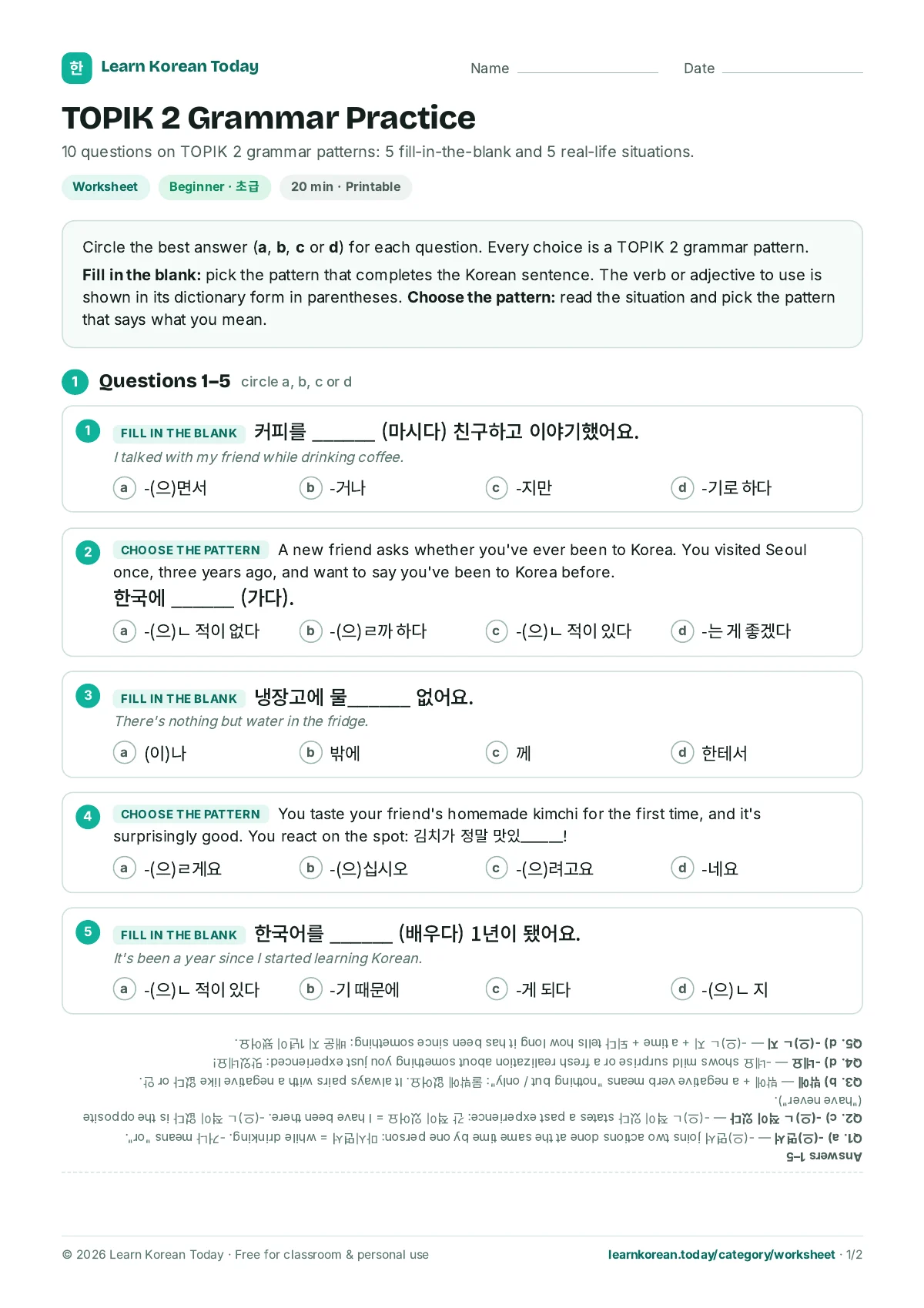
Fill in the blank.
커피를 ______ (마시다) 친구하고 이야기했어요.
I talked with my friend while drinking coffee.a) -(으)면서
b) -거나
c) -지만
d) -기로 하다Choose the pattern.
A new friend asks whether you've ever been to Korea. You visited Seoul once, three years ago, and want to say you've been to Korea before.
한국에 ______ (가다).a) -(으)ㄴ 적이 없다
b) -(으)ㄹ까 하다
c) -(으)ㄴ 적이 있다
d) -는 게 좋겠다Fill in the blank.
냉장고에 물______ 없어요.
There's nothing but water in the fridge.a) (이)나
b) 밖에
c) 께
d) 한테서Choose the pattern.
You taste your friend's homemade kimchi for the first time, and it's surprisingly good. You react on the spot: 김치가 정말 맛있______!
a) -(으)ㄹ게요
b) -(으)십시오
c) -(으)려고요
d) -네요Fill in the blank.
한국어를 ______ (배우다) 1년이 됐어요.
It's been a year since I started learning Korean.a) -(으)ㄴ 적이 있다
b) -기 때문에
c) -게 되다
d) -(으)ㄴ 지Choose the pattern.
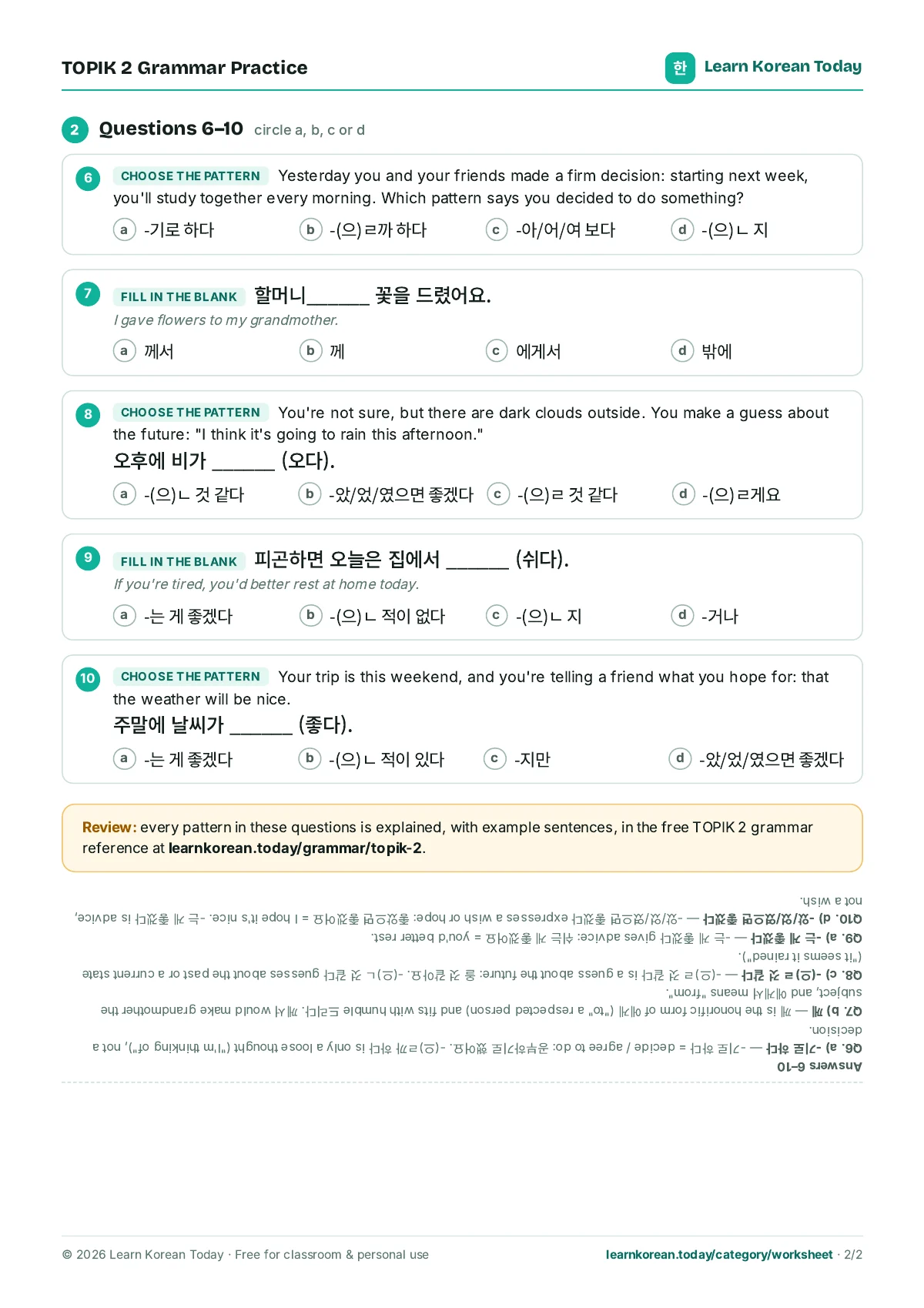
Yesterday you and your friends made a firm decision: starting next week, you'll study together every morning. Which pattern says you decided to do something?
a) -기로 하다
b) -(으)ㄹ까 하다
c) -아/어/여 보다
d) -(으)ㄴ 지Fill in the blank.
할머니______ 꽃을 드렸어요.
I gave flowers to my grandmother.a) 께서
b) 께
c) 에게서
d) 밖에Choose the pattern.
You're not sure, but there are dark clouds outside. You make a guess about the future: "I think it's going to rain this afternoon."
오후에 비가 ______ (오다).a) -(으)ㄴ 것 같다
b) -았/었/였으면 좋겠다
c) -(으)ㄹ 것 같다
d) -(으)ㄹ게요Fill in the blank.
피곤하면 오늘은 집에서 ______ (쉬다).
If you're tired, you'd better rest at home today.a) -는 게 좋겠다
b) -(으)ㄴ 적이 없다
c) -(으)ㄴ 지
d) -거나Choose the pattern.
Your trip is this weekend, and you're telling a friend what you hope for: that the weather will be nice.
주말에 날씨가 ______ (좋다).a) -는 게 좋겠다
b) -(으)ㄴ 적이 있다
c) -지만
d) -았/었/였으면 좋겠다
Show answers
Q1. a) -(으)면서 — -(으)면서 joins two actions done at the same time by one person: 마시면서 = while drinking. -거나 means "or".
Q2. c) -(으)ㄴ 적이 있다 — -(으)ㄴ 적이 있다 states a past experience: 간 적이 있어요 = I have been there. -(으)ㄴ 적이 없다 is the opposite ("have never").
Q3. b) 밖에 — 밖에 + a negative verb means "nothing but / only": 물밖에 없어요. It always pairs with a negative like 없다 or 안.
Q4. d) -네요 — -네요 shows mild surprise or a fresh realization about something you just experienced: 맛있네요!
Q5. d) -(으)ㄴ 지 — -(으)ㄴ 지 + a time + 되다 tells how long it has been since something: 배운 지 1년이 됐어요.
Q6. a) -기로 하다 — -기로 하다 = decide / agree to do: 공부하기로 했어요. -(으)ㄹ까 하다 is only a loose thought ("I'm thinking of"), not a decision.
Q7. b) 께 — 께 is the honorific form of 에게 ("to" a respected person) and fits with humble 드리다. 께서 would make grandmother the subject, and 에게서 means "from".
Q8. c) -(으)ㄹ 것 같다 — -(으)ㄹ 것 같다 is a guess about the future: 올 것 같아요. -(으)ㄴ 것 같다 guesses about the past or a current state ("it seems it rained").
Q9. a) -는 게 좋겠다 — -는 게 좋겠다 gives advice: 쉬는 게 좋겠어요 = you'd better rest.
Q10. d) -았/었/였으면 좋겠다 — -았/었/였으면 좋겠다 expresses a wish or hope: 좋았으면 좋겠어요 = I hope it's nice. -는 게 좋겠다 is advice, not a wish.
What's next
Missed a question? Every pattern is explained with example sentences in the TOPIK 2 grammar guide, and the TOPIK 2 grammar reference has a page for each one. Ready for the next step? The TOPIK 3 grammar practice worksheet has 10 more questions at the next level.
Comments (0)
Leave a Comment
Your email address will not be published. Required fields are marked *