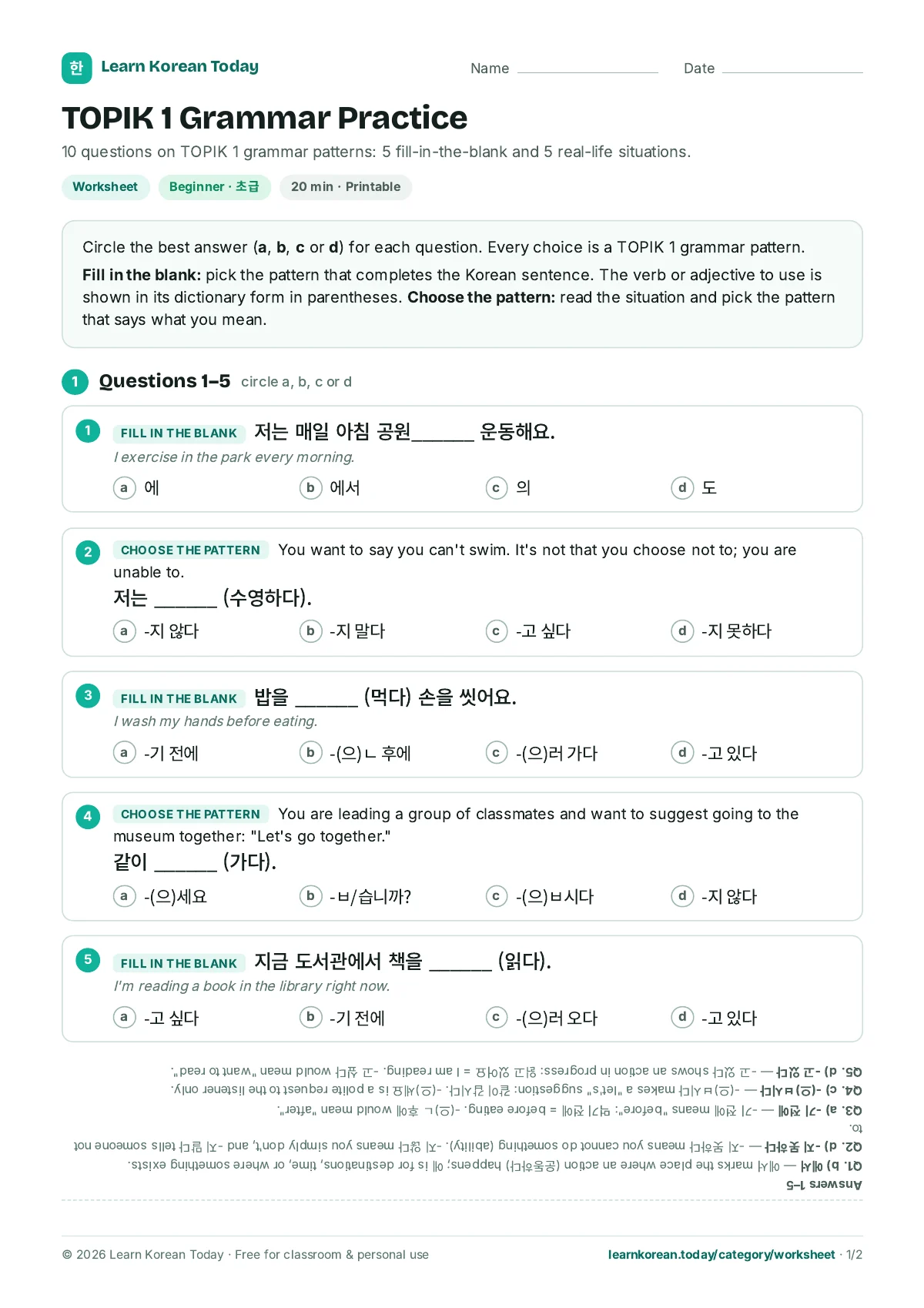
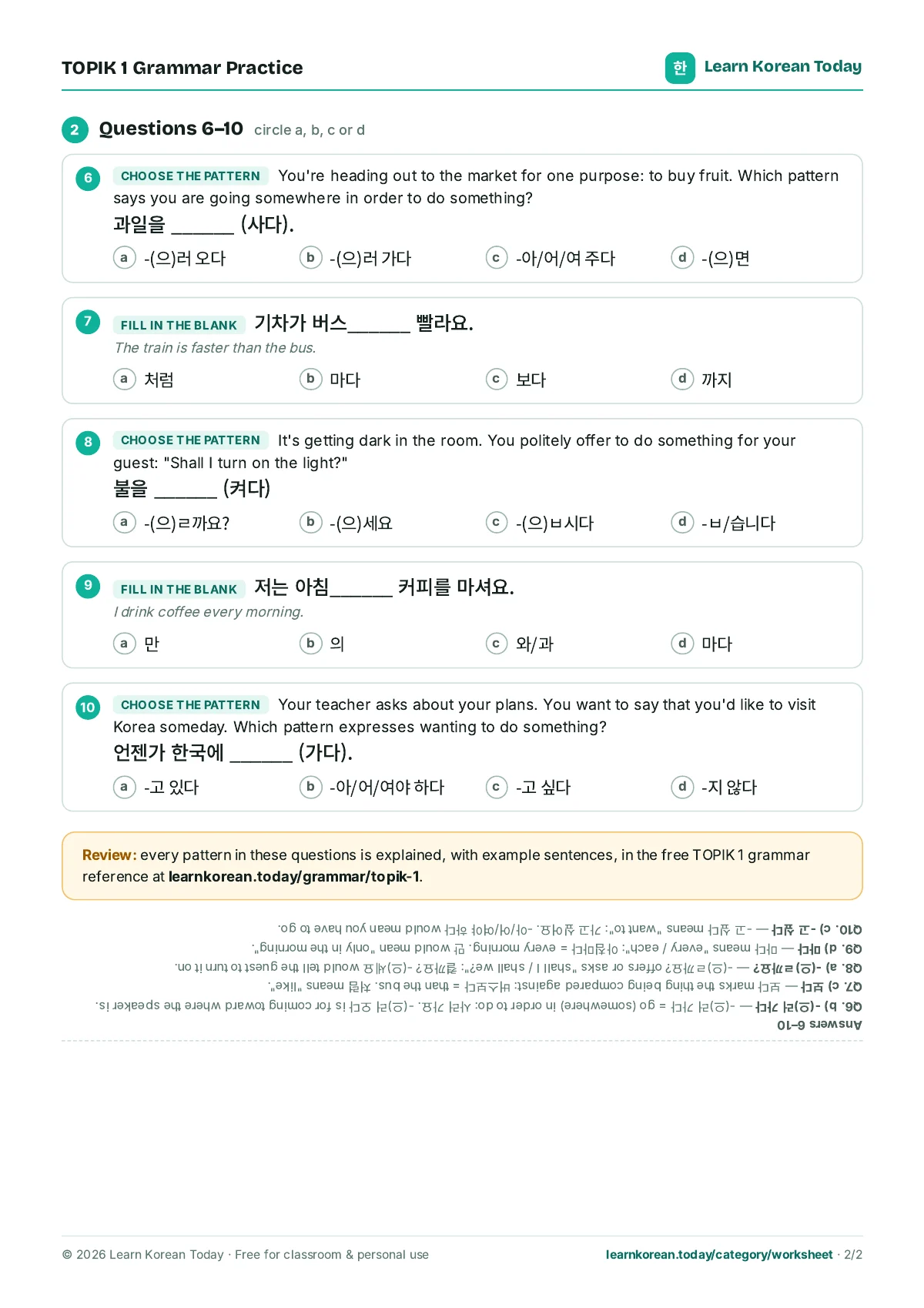
This free two-page worksheet turns the 10 practice questions from our TOPIK 1 grammar guide into a printable PDF. Five questions ask you to fill in the blank in a Korean sentence, and five describe a real-life situation and ask which pattern fits. Every choice is one of the 46 TOPIK 1 grammar patterns, so it's a quick way to check what you know before the TOPIK I exam, in class or at home.
What's inside
- 5 fill-in-the-blank questions: a Korean sentence with an English translation. Pick the pattern that completes it; the verb or adjective is given in its dictionary form.
- 5 situation questions: read a short real-life scene and choose the pattern that says what you mean.
- 4 choices per question, all TOPIK 1 patterns, so you have to know the difference, not just recognize the level.
- An answer key with explanations: one line per question on why the answer is right and what the other choices would mean.
Answers are printed upside down at the bottom of each page, so learners can check their own work.
The 10 questions
Prefer to work on screen? These are the same questions as on the worksheet. Choose the best answer for each one, then check the answers below.
Fill in the blank.
저는 매일 아침 공원______ 운동해요.
I exercise in the park every morning.a) 에
b) 에서
c) 의
d) 도Choose the pattern.
You want to say you can't swim. It's not that you choose not to; you are unable to.
저는 ______ (수영하다).a) -지 않다
b) -지 말다
c) -고 싶다
d) -지 못하다Fill in the blank.
밥을 ______ (먹다) 손을 씻어요.
I wash my hands before eating.a) -기 전에
b) -(으)ㄴ 후에
c) -(으)러 가다
d) -고 있다Choose the pattern.
You are leading a group of classmates and want to suggest going to the museum together: "Let's go together."
같이 ______ (가다).a) -(으)세요
b) -ㅂ/습니까?
c) -(으)ㅂ시다
d) -지 않다Fill in the blank.
지금 도서관에서 책을 ______ (읽다).
I'm reading a book in the library right now.a) -고 싶다
b) -기 전에
c) -(으)러 오다
d) -고 있다Choose the pattern.
You're heading out to the market for one purpose: to buy fruit. Which pattern says you are going somewhere in order to do something?
과일을 ______ (사다).a) -(으)러 오다
b) -(으)러 가다
c) -아/어/여 주다
d) -(으)면Fill in the blank.
기차가 버스______ 빨라요.
The train is faster than the bus.a) 처럼
b) 마다
c) 보다
d) 까지Choose the pattern.
It's getting dark in the room. You politely offer to do something for your guest: "Shall I turn on the light?"
불을 ______ (켜다)a) -(으)ㄹ까요?
b) -(으)세요
c) -(으)ㅂ시다
d) -ㅂ/습니다Fill in the blank.
저는 아침______ 커피를 마셔요.
I drink coffee every morning.a) 만
b) 의
c) 와/과
d) 마다Choose the pattern.
Your teacher asks about your plans. You want to say that you'd like to visit Korea someday. Which pattern expresses wanting to do something?
언젠가 한국에 ______ (가다).a) -고 있다
b) -아/어/여야 하다
c) -고 싶다
d) -지 않다
Show answers
Q1. b) 에서 — 에서 marks the place where an action (운동하다) happens; 에 is for destinations, time, or where something exists.
Q2. d) -지 못하다 — -지 못하다 means you cannot do something (ability). -지 않다 means you simply don't, and -지 말다 tells someone not to.
Q3. a) -기 전에 — -기 전에 means "before": 먹기 전에 = before eating. -(으)ㄴ 후에 would mean "after".
Q4. c) -(으)ㅂ시다 — -(으)ㅂ시다 makes a "let's" suggestion: 같이 갑시다. -(으)세요 is a polite request to the listener only.
Q5. d) -고 있다 — -고 있다 shows an action in progress: 읽고 있어요 = I am reading. -고 싶다 would mean "want to read".
Q6. b) -(으)러 가다 — -(으)러 가다 = go (somewhere) in order to do: 사러 가요. -(으)러 오다 is for coming toward where the speaker is.
Q7. c) 보다 — 보다 marks the thing being compared against: 버스보다 = than the bus. 처럼 means "like".
Q8. a) -(으)ㄹ까요? — -(으)ㄹ까요? offers or asks "shall I / shall we?": 켤까요? -(으)세요 would tell the guest to turn it on.
Q9. d) 마다 — 마다 means "every / each": 아침마다 = every morning. 만 would mean "only in the morning".
Q10. c) -고 싶다 — -고 싶다 means "want to": 가고 싶어요. -아/어/여야 하다 would mean you have to go.
What's next
Missed a question? Every pattern is explained with example sentences in the TOPIK 1 grammar guide, and the TOPIK 1 grammar reference has a page for each one. Ready for the next step? The TOPIK 2 grammar practice worksheet has 10 more questions at the next level.
Comments (0)
Leave a Comment
Your email address will not be published. Required fields are marked *