To say almost anything in Korean, you need to change the verb. The dictionary gives you 먹다 (to eat), but people actually say 먹어요 (I eat). The everyday polite ending -아요/어요 is the first verb form most learners study, and the one you'll hear most in dramas, shops and conversation. This free two-page worksheet walks through the three-step rule, the vowel contractions that make 가요, 봐요 and 마셔요, then gives you plenty of everyday verbs to practice on their own and in real sentences.
What's inside
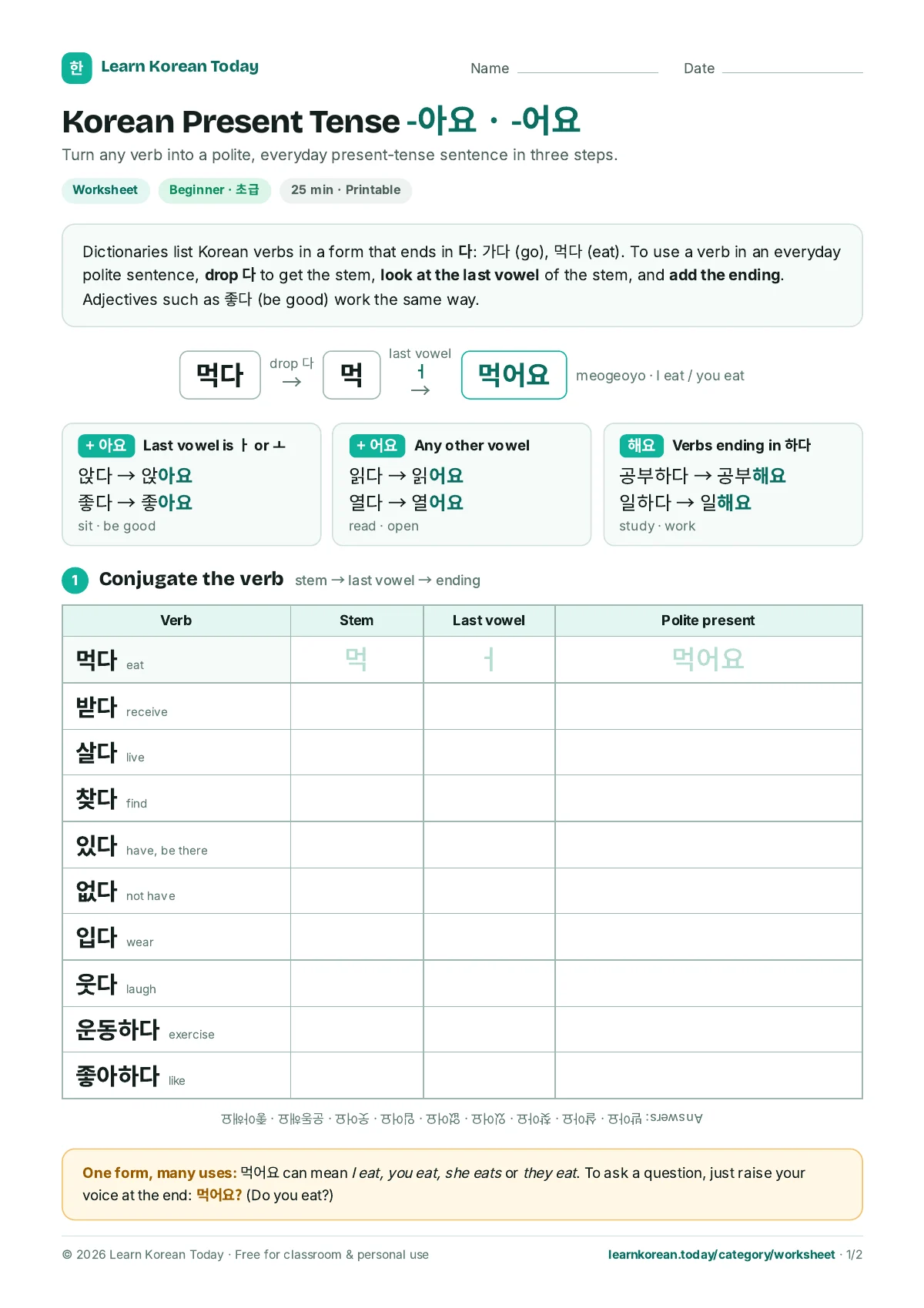
- The three-step rule: drop 다, check the last vowel, add 아요, 어요 or 해요.
- Conjugate the verb: ten common verbs to break into stem, vowel and polite form.
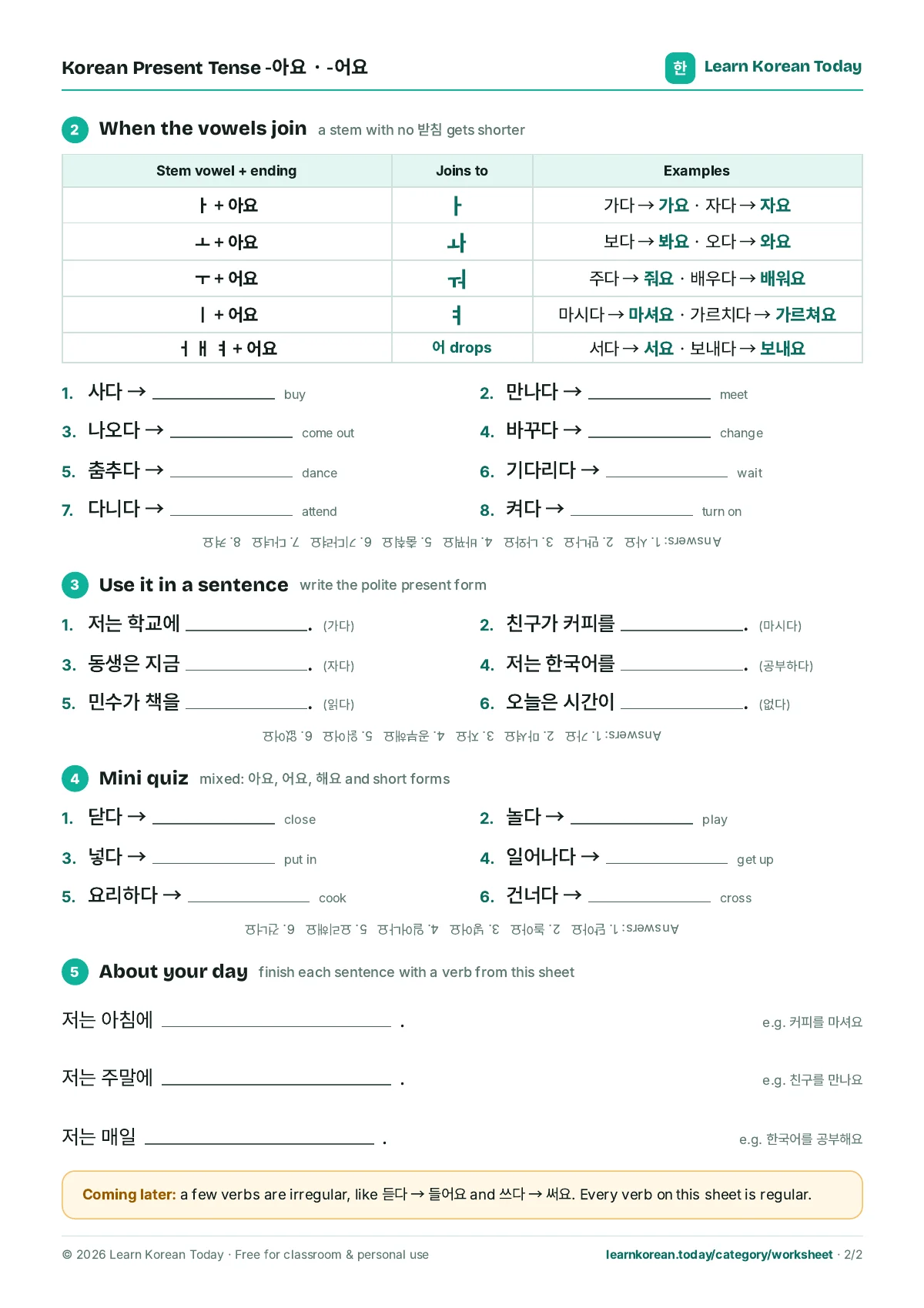
- When the vowels join: a chart of the contractions (가요, 봐요, 줘요, 마셔요) plus eight verbs to shorten.
- Use it in a sentence: six sentences that combine the verb with 은/는 and 이/가.
- Mini quiz mixing every rule, and three sentences to write about your own day.
Answers are printed upside down below each exercise. Every verb on the sheet is regular, so the rules always work.
The three-step rule
- Drop 다 to get the stem: 먹다 → 먹, 가다 → 가.
- Look at the last vowel of the stem: 먹 has ㅓ, 가 has ㅏ.
- Add the ending that matches the vowel.
| Last vowel of the stem | Ending | Examples |
|---|---|---|
| ㅏ or ㅗ | -아요 | 앉다 → 앉아요 (sit), 좋다 → 좋아요 (be good) |
| Any other vowel | -어요 | 먹다 → 먹어요 (eat), 읽다 → 읽어요 (read) |
| Verbs ending in 하다 | 해요 | 공부하다 → 공부해요 (study), 좋아하다 → 좋아해요 (like) |
One form covers every person: 먹어요 can mean I eat, you eat, she eats or they eat, and context tells you which. To make it a question, raise your voice at the end: 먹어요? (Do you eat?)
When the vowels join
If the stem ends in a vowel (no 받침), the stem vowel and the ending vowel usually merge into one syllable. Koreans almost always use the short form in speech and writing.
| Stem vowel + ending | Joins to | Examples |
|---|---|---|
| ㅏ + 아요 | ㅏ | 가다 → 가요 (go), 자다 → 자요 (sleep) |
| ㅗ + 아요 | ㅘ | 보다 → 봐요 (see), 오다 → 와요 (come) |
| ㅜ + 어요 | ㅝ | 주다 → 줘요 (give), 배우다 → 배워요 (learn) |
| ㅣ + 어요 | ㅕ | 마시다 → 마셔요 (drink), 가르치다 → 가르쳐요 (teach) |
| ㅓ, ㅐ, ㅕ + 어요 | 어 drops | 서다 → 서요 (stand), 보내다 → 보내요 (send) |
Common mistakes
- Checking the wrong vowel. Only the last vowel of the stem counts. 일어나다 starts with ㅣ but ends in ㅏ, so it's 일어나요. 배우다 starts with ㅐ but ends in ㅜ, so it's 배워요.
- Forgetting 하다 is special. 공부하다 is not 공부하아요: every verb ending in 하다 takes 해요.
- Skipping the contraction. 가아요 is never used, and 보아요 sounds bookish. Say and write 가요 and 봐요.
- Irregular verbs. A few common verbs bend the rules: 듣다 → 들어요 (listen), 쓰다 → 써요 (write), 돕다 → 도와요 (help). Learn them one at a time once the regular pattern feels easy.
Show the answers
Conjugate the verb: 받아요 · 살아요 · 찾아요 · 있어요 · 없어요 · 입어요 · 웃어요 · 운동해요 · 좋아해요
When the vowels join: 1. 사요 2. 만나요 3. 나와요 4. 바꿔요 5. 춤춰요 6. 기다려요 7. 다녀요 8. 켜요
Use it in a sentence: 1. 가요 2. 마셔요 3. 자요 4. 공부해요 5. 읽어요 6. 없어요
Mini quiz: 1. 닫아요 2. 놀아요 3. 넣어요 4. 일어나요 5. 요리해요 6. 건너요
What's next
The -아/어요 grammar page has more example sentences. To build full sentences, pair this sheet with the 은/는 and 이/가 particles worksheet. Then spot the polite present form in our beginner reading lessons, and review new verbs with flashcards.
Comments (0)
Leave a Comment
Your email address will not be published. Required fields are marked *