Korean has two sets of numbers, and you'll need both from your first day of real Korean. The price in a shop uses one set and the age on a birthday card uses the other. A clock uses both at once. This free two-page worksheet teaches 1 to 10 in each system, shows how to build bigger numbers like 365, and practices choosing the right system for money, time, age and counting.
What's inside
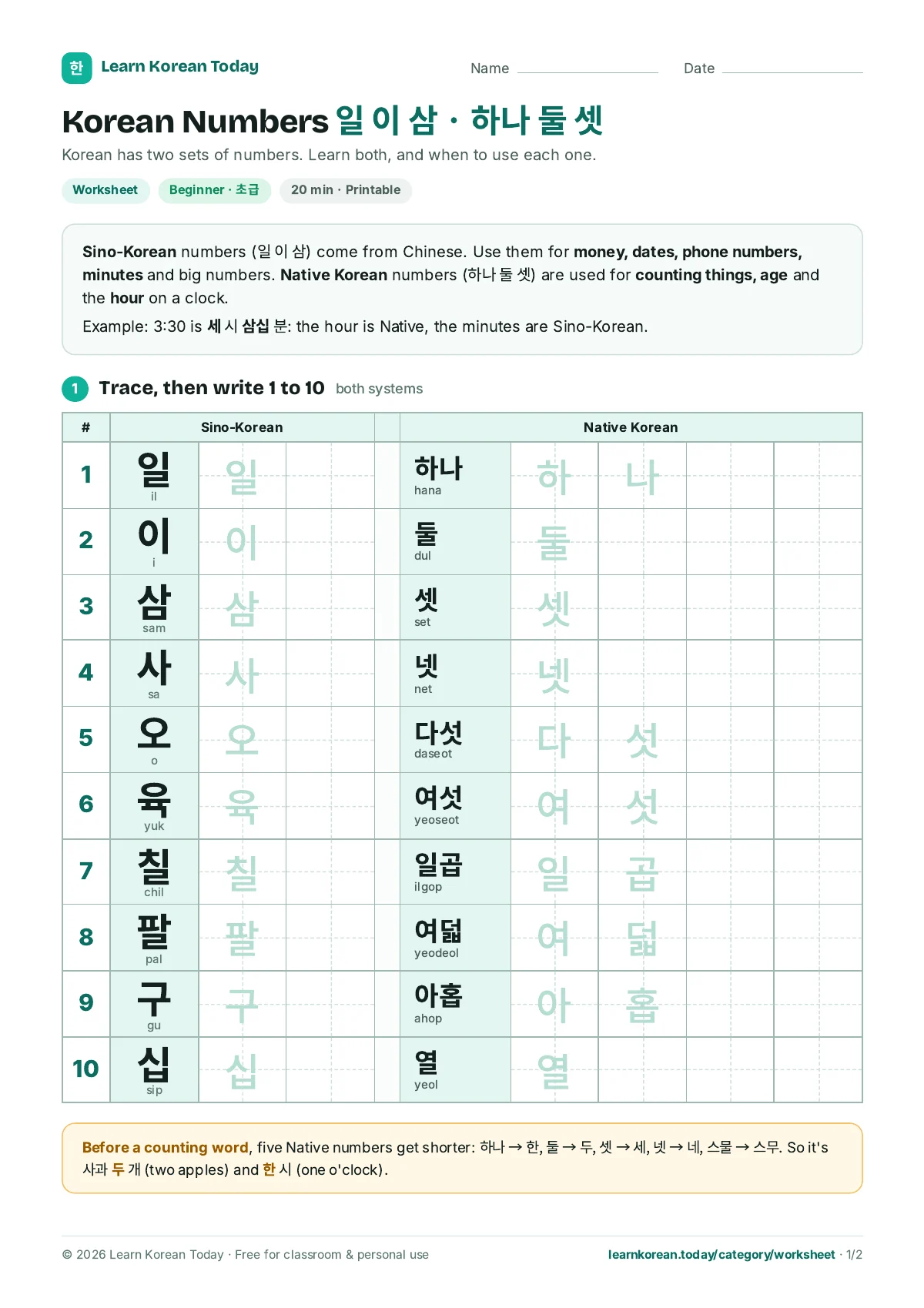
- Trace, then write 1 to 10 in Sino-Korean (일 이 삼) and Native Korean (하나 둘 셋), side by side.
- Short forms: why "two apples" is 사과 두 개 and not 사과 둘 개.
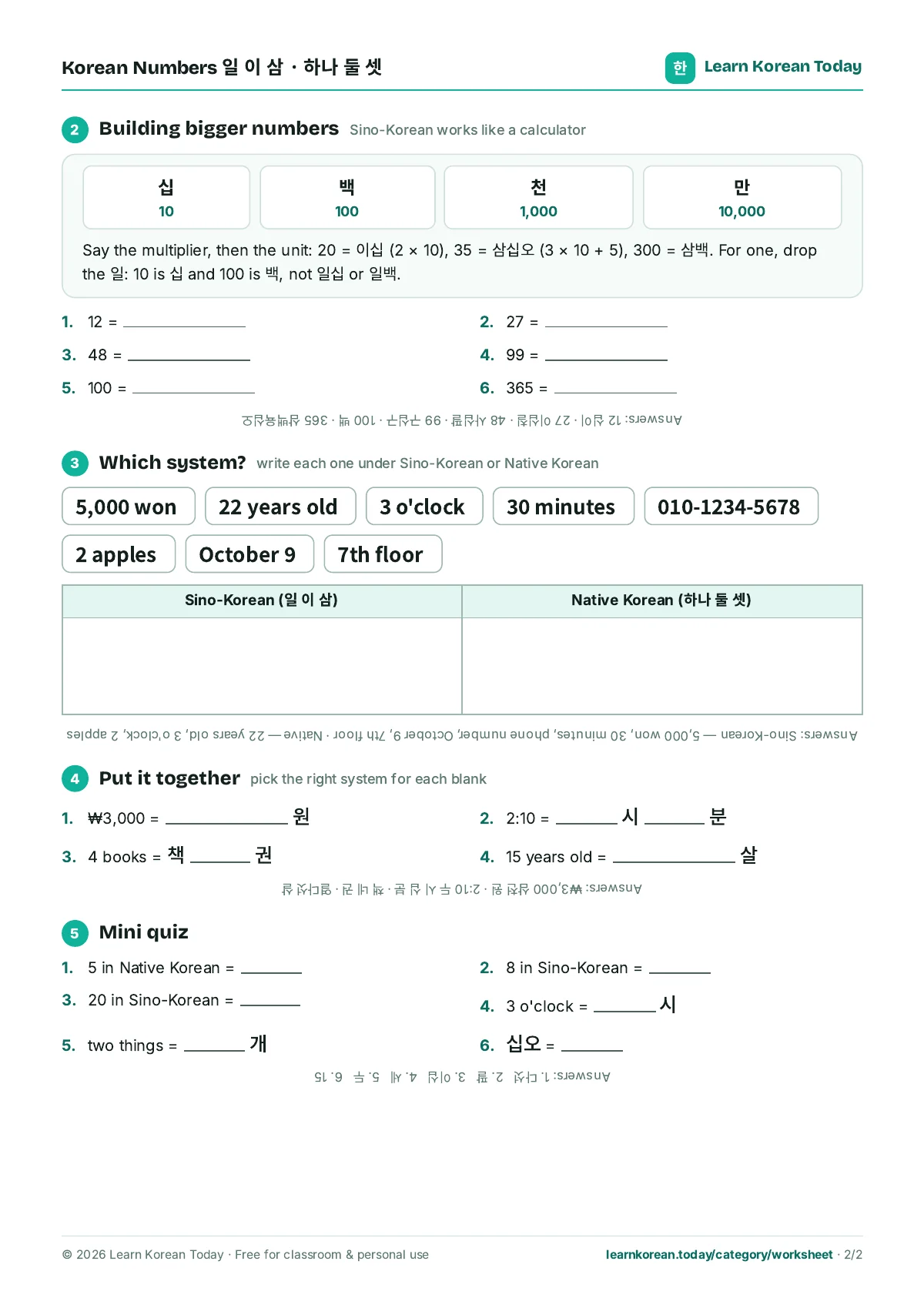
- Building bigger numbers with 십, 백, 천 and 만: write 12, 27, 48, 99, 100 and 365.
- Which system?: sort money, age, hours, minutes, phone numbers, counting, dates and floors.
- Put it together: prices, clock times, counting books and age.
- Mini quiz: six questions, with every answer printed upside down.
1 to 10 in both systems
| # | Sino-Korean | Native Korean | Short form (before a counter) |
|---|---|---|---|
| 1 | 일 (il) | 하나 (hana) | 한 |
| 2 | 이 (i) | 둘 (dul) | 두 |
| 3 | 삼 (sam) | 셋 (set) | 세 |
| 4 | 사 (sa) | 넷 (net) | 네 |
| 5 | 오 (o) | 다섯 (daseot) | 다섯 |
| 6 | 육 (yuk) | 여섯 (yeoseot) | 여섯 |
| 7 | 칠 (chil) | 일곱 (ilgop) | 일곱 |
| 8 | 팔 (pal) | 여덟 (yeodeol) | 여덟 |
| 9 | 구 (gu) | 아홉 (ahop) | 아홉 |
| 10 | 십 (sip) | 열 (yeol) | 열 |
Native numbers go up to 99 (20 is 스물, short form 스무). For 100 and above, Koreans switch to Sino-Korean.
Which system to use
| Sino-Korean (일 이 삼) | Native Korean (하나 둘 셋) |
|---|---|
| Money: 오천 원 (5,000 won) | Counting things: 사과 두 개 (two apples) |
| Minutes: 삼십 분 (30 minutes) | Hours: 세 시 (3 o'clock) |
| Dates: 시월 구 일 (October 9) | Age: 스물두 살 (22 years old) |
| Phone numbers, floors, addresses | Counting people: 세 명 (three people) |
Time uses both at once: 3:30 is 세 시 삼십 분, with a Native number for the hour and a Sino-Korean one for the minutes. One more thing to watch: two month names change slightly. June is 유월, not 육월, and October is 시월, not 십월.
Building bigger numbers
Sino-Korean numbers work like a calculator. Say the multiplier, then the unit: 20 = 이십 (2 × 10), 35 = 삼십오 (3 × 10 + 5), 300 = 삼백, 2,026 = 이천이십육. Leave out 일 in front of a unit, so 10 is 십 and 100 is 백. Korean also has a unit for 10,000: 만. That's why 50,000 won is 오만 원, not "fifty thousand".
Show the answers
Bigger numbers: 12 십이 · 27 이십칠 · 48 사십팔 · 99 구십구 · 100 백 · 365 삼백육십오
Which system: Sino-Korean: 5,000 won, 30 minutes, phone number, October 9, 7th floor · Native: 22 years old, 3 o'clock, 2 apples
Put it together: 삼천 원 · 두 시 십 분 · 책 네 권 · 열다섯 살
Quiz: 1. 다섯 2. 팔 3. 이십 4. 세 5. 두 6. 15
What's next
Numbers come up in every news story: prices, dates, percentages and ages. Try spotting them in our beginner reading lessons, and review new words with flashcards. If any letters still slow you down, the double consonants worksheet finishes the Hangul series.
Comments (0)
Leave a Comment
Your email address will not be published. Required fields are marked *