Hangul has 14 basic consonants, and learning to write them is the first step to reading Korean. This free two-page worksheet gives you one row per consonant. Each row has a model letter with an English sound hint and nine boxes to trace. Print it, trace every row, and say each sound out loud as you write.
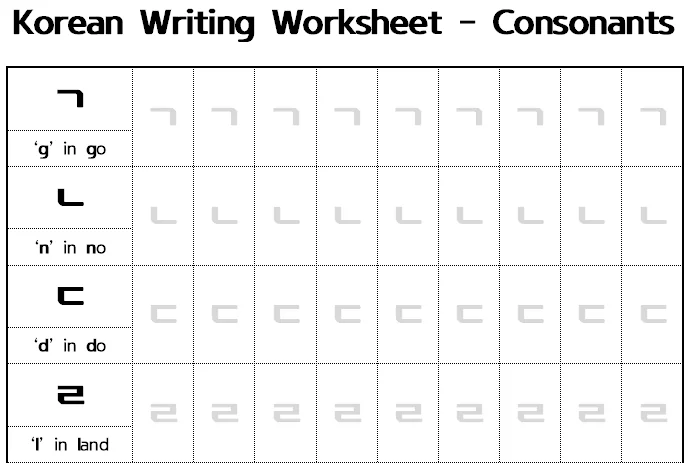
Worksheet Download
Consonants Writing Worksheet
The 14 basic consonants
| Letter | Romanization | Sounds like |
|---|---|---|
| ㄱ | g / k | "g" in go |
| ㄴ | n | "n" in no |
| ㄷ | d / t | "d" in do |
| ㄹ | r / l | a light tap between "r" and "l", like the "l" in land |
| ㅁ | m | "m" in man |
| ㅂ | b / p | "b" in boy |
| ㅅ | s | "s" in say |
| ㅇ | silent / ng | silent at the start of a syllable, "ng" in bring at the end |
| ㅈ | j | "j" in job |
| ㅊ | ch | "ch" in much, with a puff of air |
| ㅋ | k | "k" in key, with a puff of air |
| ㅌ | t | "t" in ten, with a puff of air |
| ㅍ | p | "p" in part, with a puff of air |
| ㅎ | h | "h" in he |
Tips for learning the consonants
- The shapes draw your mouth. Hangul's basic consonants were designed after the speech organs. ㄱ shows the back of the tongue touching the throat, ㄴ the tongue tip touching behind the teeth, ㅁ the closed lips, ㅅ a tooth, and ㅇ the open throat.
- An extra stroke adds air. ㅋ is ㄱ plus a stroke, and ㅌ grows from ㄷ in the same way. Add a stroke and the sound becomes stronger and breathier. ㅊ and ㅍ follow the same idea for ㅈ and ㅂ.
- Stroke order: write from top to bottom and from left to right.
- Two sounds per letter for ㄱ, ㄷ, ㅂ and ㄹ: they sound softer at the start of a word and change slightly in other positions. Don't worry about the details yet. Just learn the shape and the basic sound.
What's next
Consonants can't make a sound on their own. They need a vowel. Next, practice the 10 basic vowels with the Korean vowels worksheet. After that, you'll combine the two into syllable blocks like 가 and 나.
Comments (0)
Leave a Comment
Your email address will not be published. Required fields are marked *