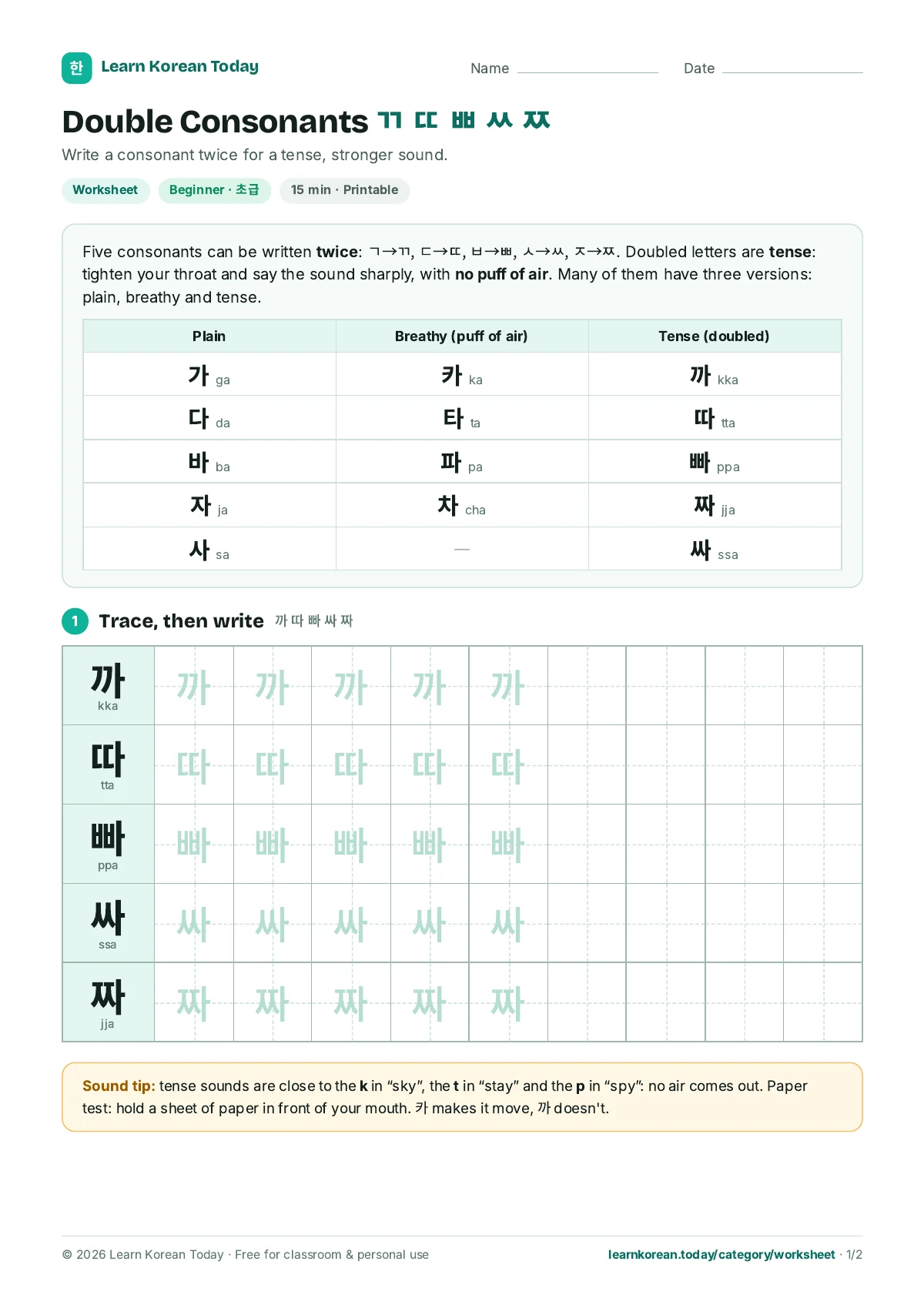
Five Korean consonants can be written twice: ㄲ, ㄸ, ㅃ, ㅆ and ㅉ. These double consonants (쌍자음, ssangjaeum) make tense sounds, and they're the last letters you need to read any Korean word. They appear in very common words like 아빠 (dad), 오빠 (older brother) and 빵 (bread). This free two-page worksheet shows how they differ from the plain and breathy consonants you already know, and gives you tracing, sorting and writing practice.
What's inside
- Plain, breathy and tense: a chart comparing 가·카·까, 다·타·따, 바·파·빠, 자·차·짜 and 사·싸.
- Trace, then write: 까 따 빠 싸 짜.
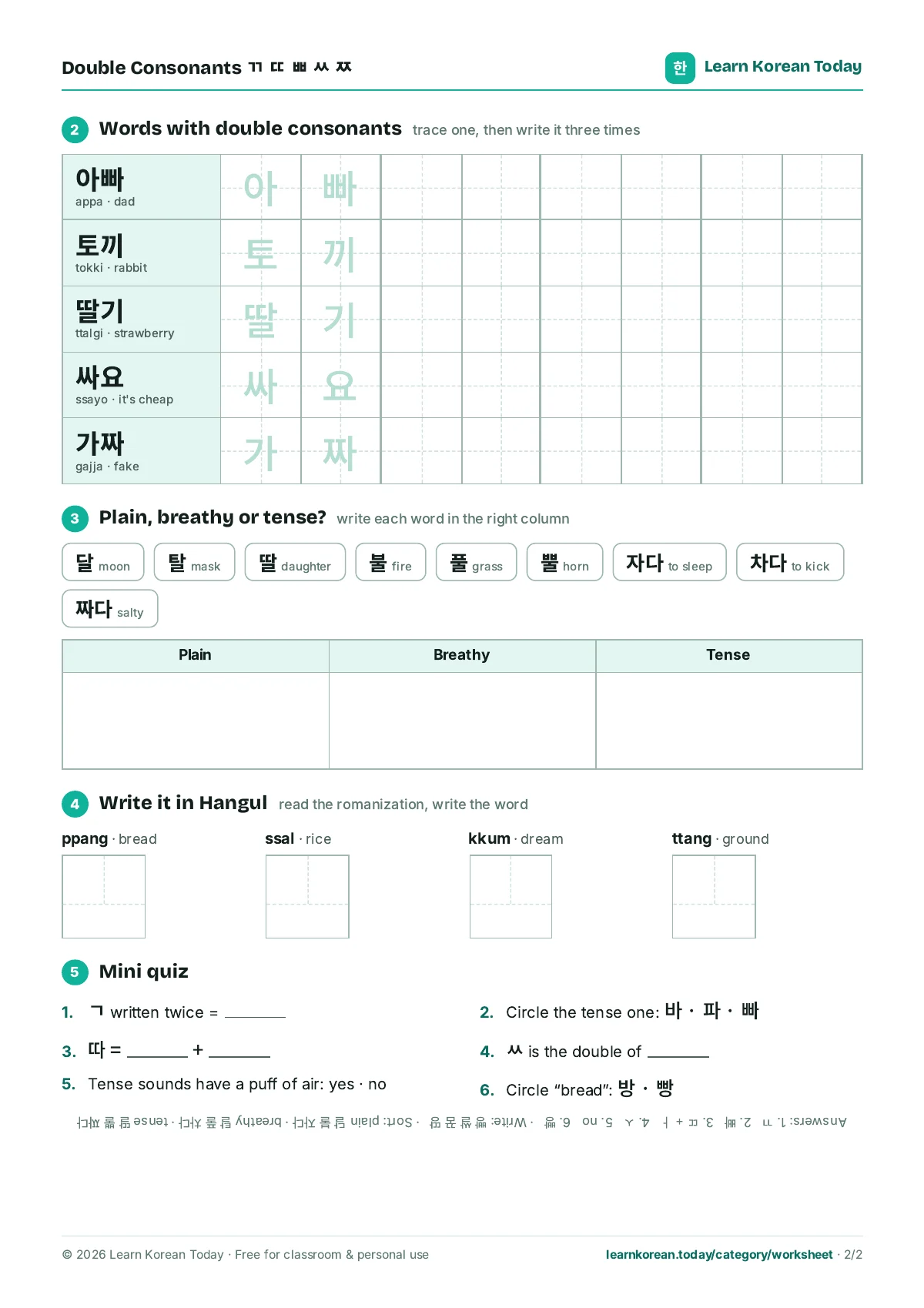
- Words with double consonants: 아빠 (dad), 토끼 (rabbit), 딸기 (strawberry), 싸요 (it's cheap), 가짜 (fake).
- Plain, breathy or tense?: sort three famous sets, 달·탈·딸, 불·풀·뿔 and 자다·차다·짜다, into the right columns.
- Write it in Hangul: ppang, ssal, kkum, ttang. These also use the 받침 you learned in the last worksheet.
- Mini quiz: six questions, with every answer printed upside down at the bottom.
Three versions of one sound
Korean doesn't separate sounds the way English does (b vs p, d vs t). It separates them by how much air comes out and how tense your throat is. Most of these consonants come in sets of three:
| Plain | Breathy | Tense | How it feels |
|---|---|---|---|
| 가 ga | 카 ka | 까 kka | Plain: relaxed, a little air Breathy: a strong puff of air Tense: throat tight, no air |
| 다 da | 타 ta | 따 tta | |
| 바 ba | 파 pa | 빠 ppa | |
| 자 ja | 차 cha | 짜 jja | |
| 사 sa | — | 싸 ssa | ㅅ has no breathy version, only ㅆ |
The difference changes meaning: 달 (moon), 탈 (mask) and 딸 (daughter) are three different words. So are 불 (fire), 풀 (grass) and 뿔 (horn).
How to make a tense sound
- Use English as a guide. The k in "sky", the t in "stay" and the p in "spy" have no puff of air. That's very close to ㄲ, ㄸ and ㅃ.
- Do the paper test. Hold a sheet of paper in front of your mouth. It should move for 카 and stay still for 까.
- Tighten and raise. Tense the muscles in your throat a little and start the syllable at a slightly higher pitch. 빵 should sound short and sharp.
- Write the same letter twice. Make each half a little narrower so the pair fits where one consonant would go.
Show the answers
Quiz: 1. ㄲ 2. 빠 3. ㄸ + ㅏ 4. ㅅ 5. no 6. 빵
Write it in Hangul: ppang 빵 (bread), ssal 쌀 (uncooked rice), kkum 꿈 (dream), ttang 땅 (ground)
Sort: plain: 달, 불, 자다 · breathy: 탈, 풀, 차다 · tense: 딸, 뿔, 짜다
What's next
That's the whole Hangul alphabet: consonants, vowels, double vowels, syllable blocks, 받침 and now the double consonants. You can now sound out almost any Korean word you see. Only a few double final consonants like the ㄺ in 닭 (chicken) are left, and you'll pick those up as you read. Put it to work with beginner reading lessons, or start learning to count with the Korean numbers worksheet. If 받침 still feels new, review the final consonants worksheet.
Comments (0)
Leave a Comment
Your email address will not be published. Required fields are marked *