This free two-page worksheet turns the 10 practice questions from our TOPIK 4 grammar guide into a printable PDF. Five questions ask you to fill in the blank in a Korean sentence, and five describe a real-life situation and ask which pattern fits. Every choice is one of the 59 TOPIK 4 grammar patterns, so it's a quick way to check what you know before the TOPIK II exam, in class or at home.
What's inside
- 5 fill-in-the-blank questions: a Korean sentence with an English translation. Pick the pattern that completes it; the verb or adjective is given in its dictionary form.
- 5 situation questions: read a short real-life scene and choose the pattern that says what you mean.
- 4 choices per question, all TOPIK 4 patterns, so you have to know the difference, not just recognize the level.
- An answer key with explanations: one line per question on why the answer is right and what the other choices would mean.
Answers are printed upside down at the bottom of each page, so learners can check their own work.
The 10 questions
Prefer to work on screen? These are the same questions as on the worksheet. Choose the best answer for each one, then check the answers below.
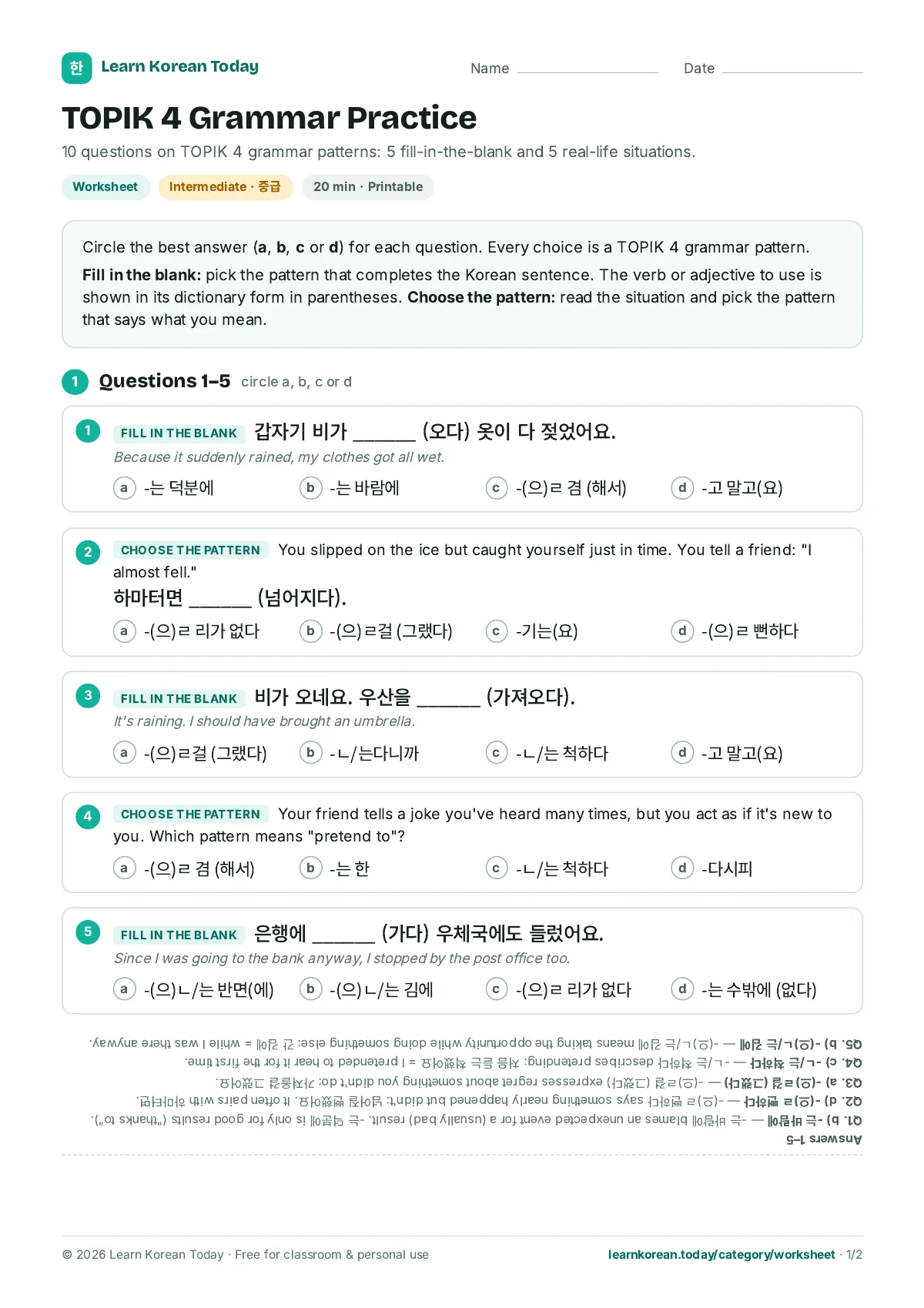
Fill in the blank.
갑자기 비가 ______ (오다) 옷이 다 젖었어요.
Because it suddenly rained, my clothes got all wet.a) -는 덕분에
b) -는 바람에
c) -(으)ㄹ 겸 (해서)
d) -고 말고(요)Choose the pattern.
You slipped on the ice but caught yourself just in time. You tell a friend: "I almost fell."
하마터면 ______ (넘어지다).a) -(으)ㄹ 리가 없다
b) -(으)ㄹ걸 (그랬다)
c) -기는(요)
d) -(으)ㄹ 뻔하다Fill in the blank.
비가 오네요. 우산을 ______ (가져오다).
It's raining. I should have brought an umbrella.a) -(으)ㄹ걸 (그랬다)
b) -ㄴ/는다니까
c) -ㄴ/는 척하다
d) -고 말고(요)Choose the pattern.
Your friend tells a joke you've heard many times, but you act as if it's new to you. Which pattern means "pretend to"?
a) -(으)ㄹ 겸 (해서)
b) -는 한
c) -ㄴ/는 척하다
d) -다시피Fill in the blank.
은행에 ______ (가다) 우체국에도 들렀어요.
Since I was going to the bank anyway, I stopped by the post office too.a) -(으)ㄴ/는 반면(에)
b) -(으)ㄴ/는 김에
c) -(으)ㄹ 리가 없다
d) -는 수밖에 (없다)Choose the pattern.
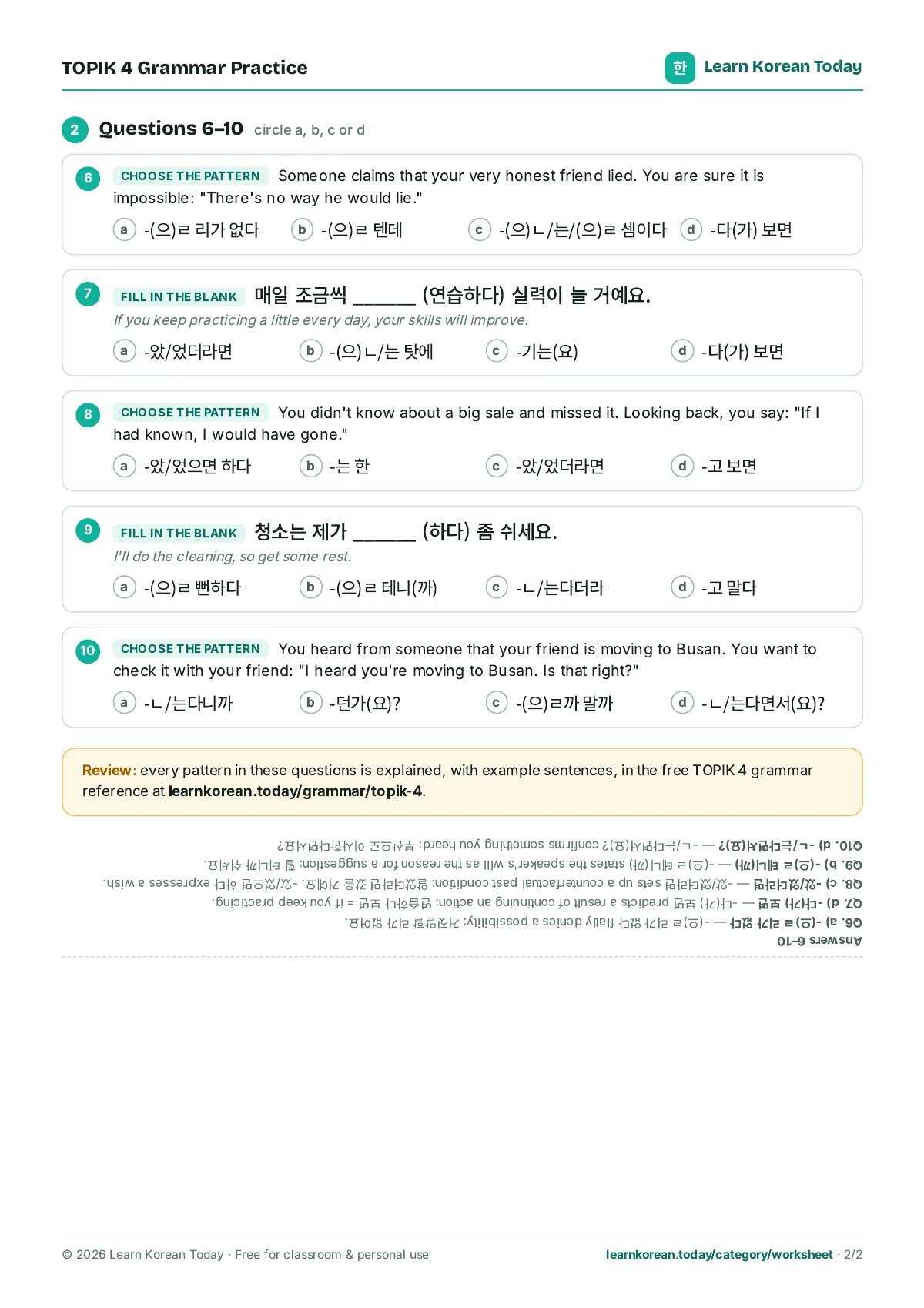
Someone claims that your very honest friend lied. You are sure it is impossible: "There's no way he would lie."
a) -(으)ㄹ 리가 없다
b) -(으)ㄹ 텐데
c) -(으)ㄴ/는/(으)ㄹ 셈이다
d) -다(가) 보면Fill in the blank.
매일 조금씩 ______ (연습하다) 실력이 늘 거예요.
If you keep practicing a little every day, your skills will improve.a) -았/었더라면
b) -(으)ㄴ/는 탓에
c) -기는(요)
d) -다(가) 보면Choose the pattern.
You didn't know about a big sale and missed it. Looking back, you say: "If I had known, I would have gone."
a) -았/었으면 하다
b) -는 한
c) -았/었더라면
d) -고 보면Fill in the blank.
청소는 제가 ______ (하다) 좀 쉬세요.
I'll do the cleaning, so get some rest.a) -(으)ㄹ 뻔하다
b) -(으)ㄹ 테니(까)
c) -ㄴ/는다더라
d) -고 말다Choose the pattern.
You heard from someone that your friend is moving to Busan. You want to check it with your friend: "I heard you're moving to Busan. Is that right?"
a) -ㄴ/는다니까
b) -던가(요)?
c) -(으)ㄹ까 말까
d) -ㄴ/는다면서(요)?
Show answers
Q1. b) -는 바람에 — -는 바람에 blames an unexpected event for a (usually bad) result. -는 덕분에 is only for good results ("thanks to").
Q2. d) -(으)ㄹ 뻔하다 — -(으)ㄹ 뻔하다 says something nearly happened but didn't: 넘어질 뻔했어요. It often pairs with 하마터면.
Q3. a) -(으)ㄹ걸 (그랬다) — -(으)ㄹ걸 (그랬다) expresses regret about something you didn't do: 가져올걸 그랬어요.
Q4. c) -ㄴ/는 척하다 — -ㄴ/는 척하다 describes pretending: 처음 듣는 척했어요 = I pretended to hear it for the first time.
Q5. b) -(으)ㄴ/는 김에 — -(으)ㄴ/는 김에 means taking the opportunity while doing something else: 간 김에 = while I was there anyway.
Q6. a) -(으)ㄹ 리가 없다 — -(으)ㄹ 리가 없다 flatly denies a possibility: 거짓말할 리가 없어요.
Q7. d) -다(가) 보면 — -다(가) 보면 predicts a result of continuing an action: 연습하다 보면 = if you keep practicing.
Q8. c) -았/었더라면 — -았/었더라면 sets up a counterfactual past condition: 알았더라면 갔을 거예요. -았/었으면 하다 expresses a wish.
Q9. b) -(으)ㄹ 테니(까) — -(으)ㄹ 테니(까) states the speaker's will as the reason for a suggestion: 할 테니까 쉬세요.
Q10. d) -ㄴ/는다면서(요)? — -ㄴ/는다면서(요)? confirms something you heard: 부산으로 이사한다면서요?
What's next
Missed a question? Every pattern is explained with example sentences in the TOPIK 4 grammar guide, and the TOPIK 4 grammar reference has a page for each one. Ready for the next step? The TOPIK 5 grammar practice worksheet has 10 more questions at the next level.
Comments (0)
Leave a Comment
Your email address will not be published. Required fields are marked *