Korean has 10 basic vowels, and they're built from just three simple strokes: a dot (now a short line), a horizontal line and a vertical line. This free one-page worksheet gives you a row for each vowel, with a model letter, its romanization and nine boxes to trace. Once you know these, the double vowels are easy, because they're made by combining them.
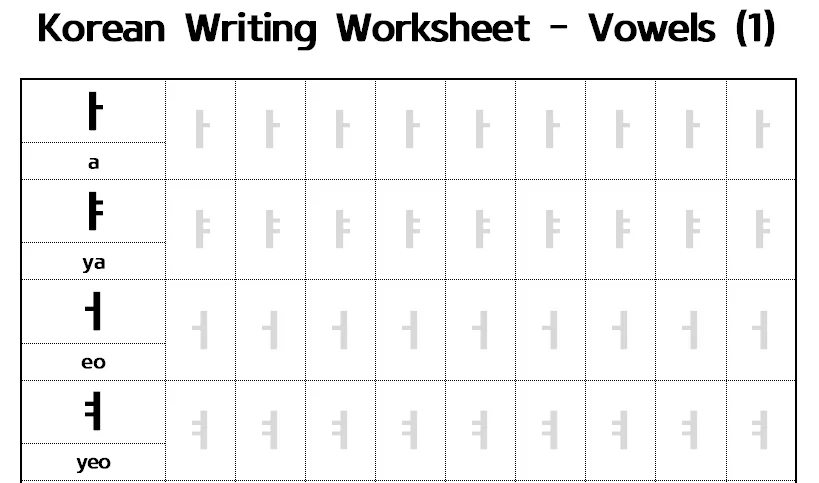
Worksheet Download
Vowels Writing Worksheet
The 10 basic vowels
| Vowel | Romanization | Sounds like |
|---|---|---|
| ㅏ | a | "a" in father |
| ㅑ | ya | "ya" in yard |
| ㅓ | eo | "u" in fun, with the mouth a little more open |
| ㅕ | yeo | "yu" in yummy |
| ㅗ | o | "o" in go, with rounded lips and no "w" at the end |
| ㅛ | yo | "yo" in yoga |
| ㅜ | u | "oo" in moon |
| ㅠ | yu | "you" |
| ㅡ | eu | like "oo" but with the lips spread flat, as in a smile |
| ㅣ | i | "ee" in see |
Tips for learning the vowels
- A second short stroke adds a "y" sound. ㅏ becomes ㅑ (a → ya), ㅓ becomes ㅕ, ㅗ becomes ㅛ and ㅜ becomes ㅠ. That's four new vowels for free.
- Tall or flat? ㅏ ㅑ ㅓ ㅕ ㅣ are tall, so they sit to the right of a consonant (가). ㅗ ㅛ ㅜ ㅠ ㅡ are flat, so they sit under it (고). This matters as soon as you start writing syllables.
- Stroke order: top to bottom, left to right. For ㅏ, draw the long vertical line first, then the short stroke.
- ㅓ vs ㅗ is the hardest pair for English speakers. Keep your lips relaxed for ㅓ and rounded for ㅗ.
What's next
Next, learn the 11 combined vowels with the Korean double vowels worksheet. If you haven't practiced the consonants yet, start with the consonants worksheet.
Comments (0)
Leave a Comment
Your email address will not be published. Required fields are marked *