Almost every Korean sentence you'll read has 은/는 or 이/가 in it. They are tiny, but they tell you what a sentence is about and who is doing what. This free two-page worksheet covers both jobs. You'll pick the right form for any noun (은 or 는, 이 or 가), learn four simple rules for choosing between the topic and subject particle, and fix the forms learners get wrong most often, like 제가 and 누가.
What's inside
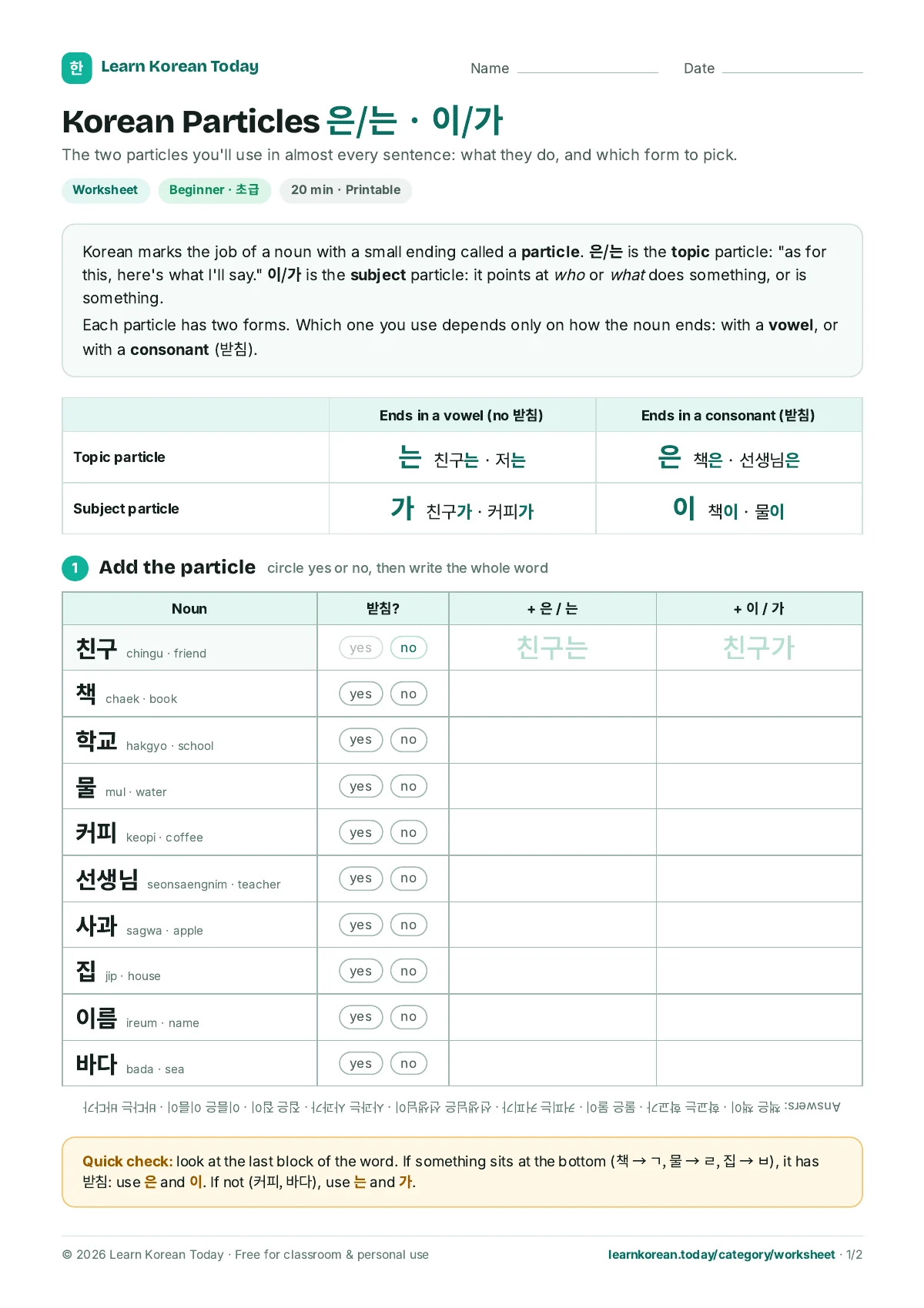
- Which form?: a one-glance chart of 은/는 and 이/가 after vowels and consonants.
- Add the particle: decide if ten everyday nouns end in 받침, then write each with both particles.
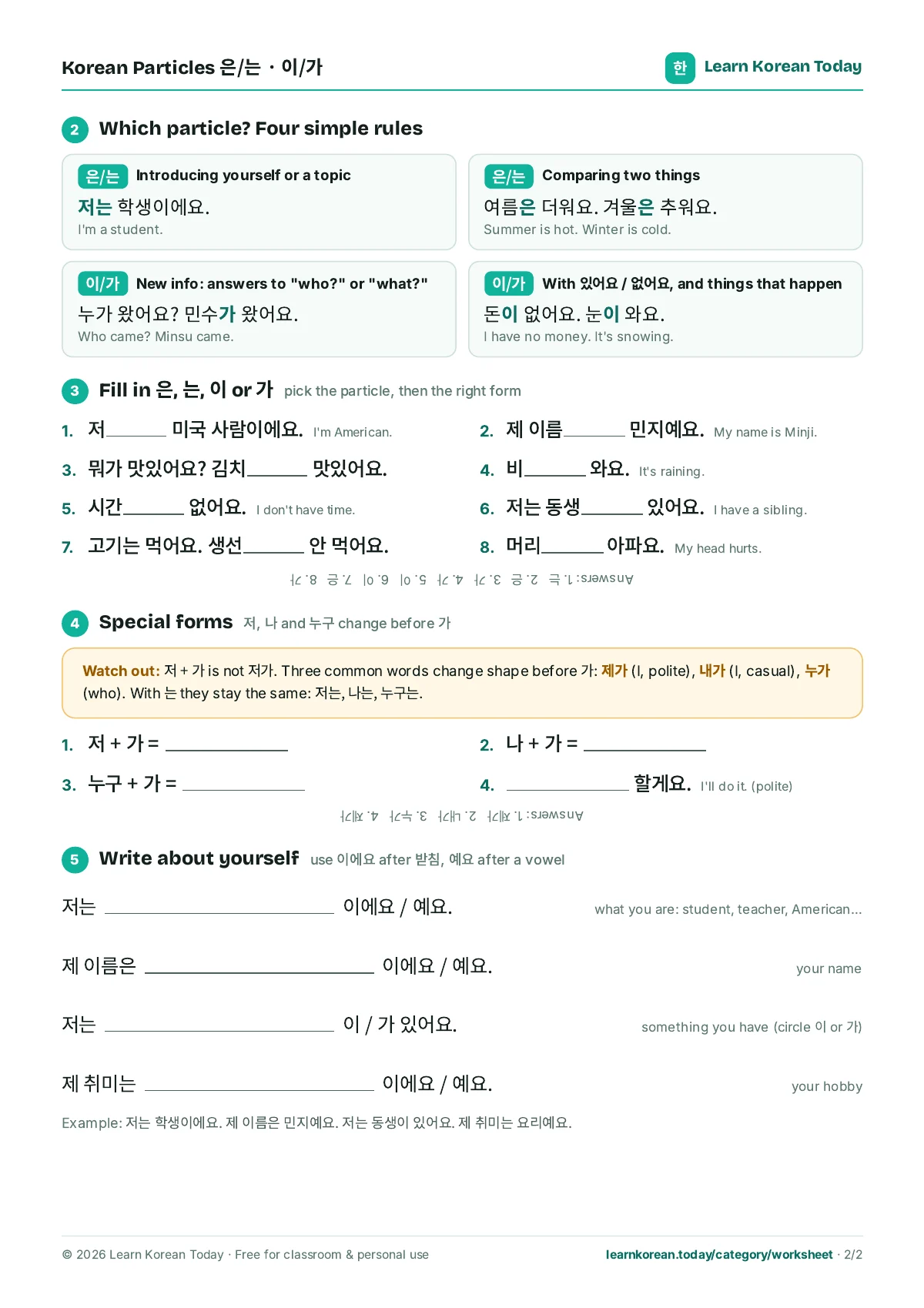
- Four simple rules for choosing between the topic particle and the subject particle.
- Fill in 은, 는, 이 or 가: eight short sentences about names, weather, time and food.
- Special forms: why "I" is 제가, not 저가, and "who" is 누가, not 누구가.
- Write about yourself: four sentence frames to introduce yourself with both particles.
Answers are printed upside down at the bottom of each exercise, so learners can check their own work.
은 or 는? 이 or 가?
Each particle has two forms, and the choice depends only on the last letter of the noun. If the last block ends in a consonant at the bottom (a 받침), use the form that starts with a vowel sound. That keeps the word easy to say.
| After a vowel | After a consonant (받침) | |
|---|---|---|
| Topic particle | 는: 친구는, 저는, 커피는 | 은: 책은, 선생님은, 물은 |
| Subject particle | 가: 친구가, 커피가, 바다가 | 이: 책이, 선생님이, 물이 |
The same vowel-or-consonant rule shows up all over Korean. The worksheet's last exercise uses it again for 이에요 and 예요: 학생이에요 after a consonant, 의사예요 after a vowel.
Topic or subject: which one to use
Even native speakers can't always explain the difference, and in many sentences either one works with a small change in nuance. For beginners, these four rules cover most everyday Korean:
| Use | When | Example |
|---|---|---|
| 은/는 | Introducing yourself or setting the topic | 저는 학생이에요. (I'm a student.) |
| 은/는 | Comparing or contrasting two things | 여름은 더워요. 겨울은 추워요. (Summer is hot. Winter is cold.) |
| 이/가 | New information, and answers to "who?" or "what?" | 누가 왔어요? 민수가 왔어요. (Who came? Minsu came.) |
| 이/가 | With 있어요 / 없어요, weather and things that happen | 시간이 없어요. 비가 와요. (I don't have time. It's raining.) |
A sentence can use both at once. In 저는 동생이 있어요 (I have a younger sibling), 저는 sets the topic ("as for me") and 동생이 is the subject of 있어요 ("a sibling exists"). The same pattern gives you 저는 커피가 좋아요 (I like coffee) and 저는 머리가 아파요 (I have a headache).
Common mistakes
- 저가 → 제가. Before 가, 저 (I) becomes 제, 나 (I, casual) becomes 내, and 누구 (who) becomes 누. With 는 nothing changes: 저는, 나는, 누구는.
- Question words take 이/가. Ask 누가 왔어요? or 뭐가 맛있어요?, and answer with 이/가 too: 김치가 맛있어요.
- No space before a particle. Particles attach straight to the noun: 저는, not 저 는, and 친구가, not 친구 가.
Show the answers
Add the particle: 책은 책이 · 학교는 학교가 · 물은 물이 · 커피는 커피가 · 선생님은 선생님이 · 사과는 사과가 · 집은 집이 · 이름은 이름이 · 바다는 바다가
Fill in: 1. 는 2. 은 3. 가 4. 가 5. 이 6. 이 7. 은 8. 가
Special forms: 1. 제가 2. 내가 3. 누가 4. 제가
Write about yourself (example): 저는 학생이에요. 제 이름은 민지예요. 저는 동생이 있어요. 제 취미는 요리예요.
What's next
For more examples and finer points, see the grammar reference pages for 은/는 and 이/가. Then look for both particles in our beginner reading lessons: try to say why each sentence uses the one it does. Next, the present tense -아요/어요 worksheet adds the verb at the end of the sentence. If 받침 still trips you up, the final consonants worksheet is a quick review.
Comments (0)
Leave a Comment
Your email address will not be published. Required fields are marked *